

Kidde Australia was recently awarded a major package on one of Australia’s largest transport infrastructure developments currently under construction. The project spans multiple operational facilities, including telecommunications rooms, electrical switch rooms, and critical control infrastructure distributed across numerous sites.
Major transport infrastructure projects place unique demands on fire protection systems, where uptime, safety, and sustainability must be balanced across multiple critical sites. Reliability, maintainability, environmental considerations and whole-of-life costs all play a part in the decision-making process.
Given the role these facilities play in the day-to-day operation of the network, maintaining system availability was a key consideration. At the same time, the project team was seeking solutions that aligned with broader sustainability objectives established for the development.

Why KIDDE Natura System Was Selected
The facilities contained a range of sensitive electronic equipment where water-based suppression systems were not considered suitable.
Following evaluation of the available suppression technologies, the project team selected the Kidde Natura inert gas suppression system because of its distinct credentials, installation and maintenance advantages.
The use of naturally occurring inert gases aligned with the project’s sustainability objectives while providing a proven fire protection solution for occupied spaces containing sensitive electronic equipment. With zero ozone depletion potential and zero global warming potential, Natura offered an environmentally responsible approach without compromising suppression performance.
Environmental performance was one consideration; however operational and maintenance requirements also played an important role in the selection process.
Simplifying Testing and Ongoing Maintenance
One aspect of the Natura system that attracted particular interest during the design review process was the ability to physically verify pilot-line operation during testing.
For maintenance personnel responsible for the system over its operational life, visual verification of valve operation provides maintenance teams with immediate confirmation of system performance, reducing reliance on additional test equipment and simplifying routine testing. On a project involving multiple protected spaces, this was viewed as a practical advantage during commissioning and future maintenance activities.
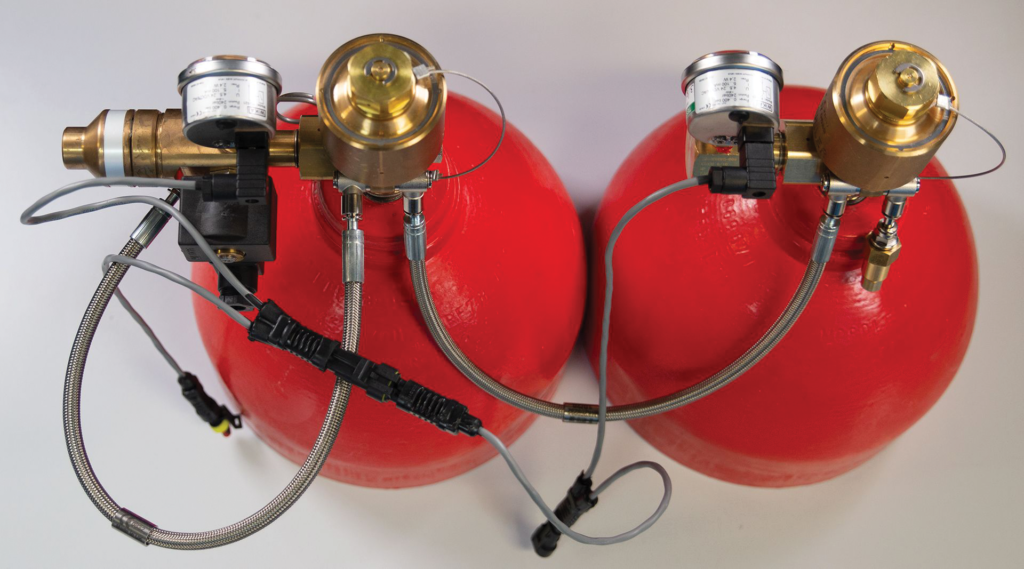
The Natura valve incorporates a pressure-actuated blow-out indicator that provides a clear visual confirmation of pilot-line operation. While relatively simple in concept, features such as this can simplify routine testing procedures and reduce the reliance on additional test equipment.

Installation Across Multiple Facilities
The scale of the project also meant that installation efficiency was considered during system selection.
Kidde’s Natura platform incorporates quick-connect actuation hoses, reducing the amount of pilot-line hardware and threaded fittings required throughout the system. This simplified installation and reduced the potential for assembly errors, while also improving access around cylinder banks for future servicing.
The valve arrangement also allowed a cleaner installation within the cylinder storage areas, which was particularly beneficial where space and access requirements needed to be considered from the outset.
For projects with multiple protected spaces, Natura’s directional valve capability also enables a common cylinder bank to protect several hazards, reducing installation time, minimising potential leak points, and improving long-term serviceability.

Delivering Operational and Lifecycle Benefits
In practice, the Kidde Natura inert gas suppression system delivered a combination of operational resilience and long-term efficiency for the project. Installation across multiple facilities was streamlined through reduced system complexity, while commissioning was simplified through clear, physical verification of system operation.
Over the life of the asset, maintenance requirements are expected to be more straightforward, reducing both time and dependency on specialist test equipment. Importantly, the system also supports the project’s sustainability objectives without compromising protection, providing a balanced solution that aligns performance, environmental responsibility, and whole-of-life cost considerations.

Protecting Sensitive Equipment
The facilities included communications and control equipment that would be expected to remain operational following a suppression system discharge.
As a result, the project team considered not only the extinguishing performance of the system but also the effects of discharge on the equipment being protected.
To address this, Kidde’s acoustic silencers were incorporated into the design. Developed specifically for inert gas applications, the silencers help reduce discharge noise levels within protected spaces and are particularly suited to environments containing sensitive electronic equipment.
This provided an additional level of protection for critical infrastructure while allowing the benefits of inert gas suppression to be maintained.

Meeting Project Objectives
Like many major infrastructure projects, the final fire protection strategy was influenced by a combination of operational, environmental and maintenance considerations.
For this application, the Kidde Natura inert gas suppression system delivered more than a compliant fire protection solution. The combination of environmentally responsible extinguishing agents, simplified testing capability, installation efficiencies and protection for sensitive equipment aligned closely with the objectives established by the project stakeholders.
As infrastructure owners increasingly prioritise resilience and sustainability, solutions that combine environmental performance with operational efficiency, such as Kidde Natura, are becoming the preferred standard for critical asset protection.
For more information, go to www.kidde.com.au
About the Author

This post was uploaded by Mark Seton.
- Mark Seton
- Mark Seton
- Mark Seton
- Mark Seton
- Mark Seton
- Mark Seton
- Mark Seton
- Mark Seton
- Mark Seton
- Mark Seton
- Mark Seton
- Mark Seton
- Mark Seton
- Mark Seton
- Mark Seton
- Mark Seton
- Mark Seton
- Mark Seton
- Mark Seton
- Mark Seton
- Mark Seton
- Mark Seton
- Mark Seton
- Mark Seton
- Mark Seton
- Mark Seton
- Mark Seton
- Mark Seton
- Mark Seton
- Mark Seton
- Mark Seton
- Mark Seton
- Mark Seton
- Mark Seton
- Mark Seton
- Mark Seton
- Mark Seton
- Mark Seton
- Mark Seton
- Mark Seton
- Mark Seton
- Mark Seton
- Mark Seton
- Mark Seton
- Mark Seton
- Mark Seton
- Mark Seton
- Mark Seton
- Mark Seton
- Mark Seton
- Mark Seton
- Mark Seton
- Mark Seton
- Mark Seton
- Mark Seton
- Mark Seton
- Mark Seton
- Mark Seton
- Mark Seton
- Mark Seton
- Mark Seton
- Mark Seton
- Mark Seton
- Mark Seton
- Mark Seton
- Mark Seton
- Mark Seton
- Mark Seton
- Mark Seton
- Mark Seton
- Mark Seton
- Mark Seton
- Mark Seton
- Mark Seton
- Mark Seton
- Mark Seton
- Mark Seton
- Mark Seton
- Mark Seton
- Mark Seton
- Mark Seton
- Mark Seton
- Mark Seton
- Mark Seton
- Mark Seton
- Mark Seton
- Mark Seton
- Mark Seton
- Mark Seton
- Mark Seton
- Mark Seton
- Mark Seton
- Mark Seton
- Mark Seton
- Mark Seton
- Mark Seton
- Mark Seton
- Mark Seton
- Mark Seton
- Mark Seton
- Mark Seton
- Mark Seton
- Mark Seton
- Mark Seton
- Mark Seton
- Mark Seton
- Mark Seton
- Mark Seton
- Mark Seton
- Mark Seton
- Mark Seton
- Mark Seton
- Mark Seton
- Mark Seton
- Mark Seton
- Mark Seton
- Mark Seton
- Mark Seton
- Mark Seton
- Mark Seton
- Mark Seton
- Mark Seton
- Mark Seton
- Mark Seton
- Mark Seton
- Mark Seton
- Mark Seton
- Mark Seton
- Mark Seton
- Mark Seton
- Mark Seton
- Mark Seton
- Mark Seton
- Mark Seton
- Mark Seton
- Mark Seton
- Mark Seton
- Mark Seton
- Mark Seton
- Mark Seton
- Mark Seton
- Mark Seton
- Mark Seton
- Mark Seton
- Mark Seton
- Mark Seton
- Mark Seton
- Mark Seton
- Mark Seton
- Mark Seton
- Mark Seton
- Mark Seton
- Mark Seton
- Mark Seton
- Mark Seton
- Mark Seton
- Mark Seton
- Mark Seton
- Mark Seton
- Mark Seton
- Mark Seton
- Mark Seton
- Mark Seton
- Mark Seton
- Mark Seton
- Mark Seton
- Mark Seton
- Mark Seton
- Mark Seton
- Mark Seton
- Mark Seton
- Mark Seton
- Mark Seton
- Mark Seton
- Mark Seton
- Mark Seton
- Mark Seton
- Mark Seton
- Mark Seton
- Mark Seton
- Mark Seton
- Mark Seton
- Mark Seton
- Mark Seton
