
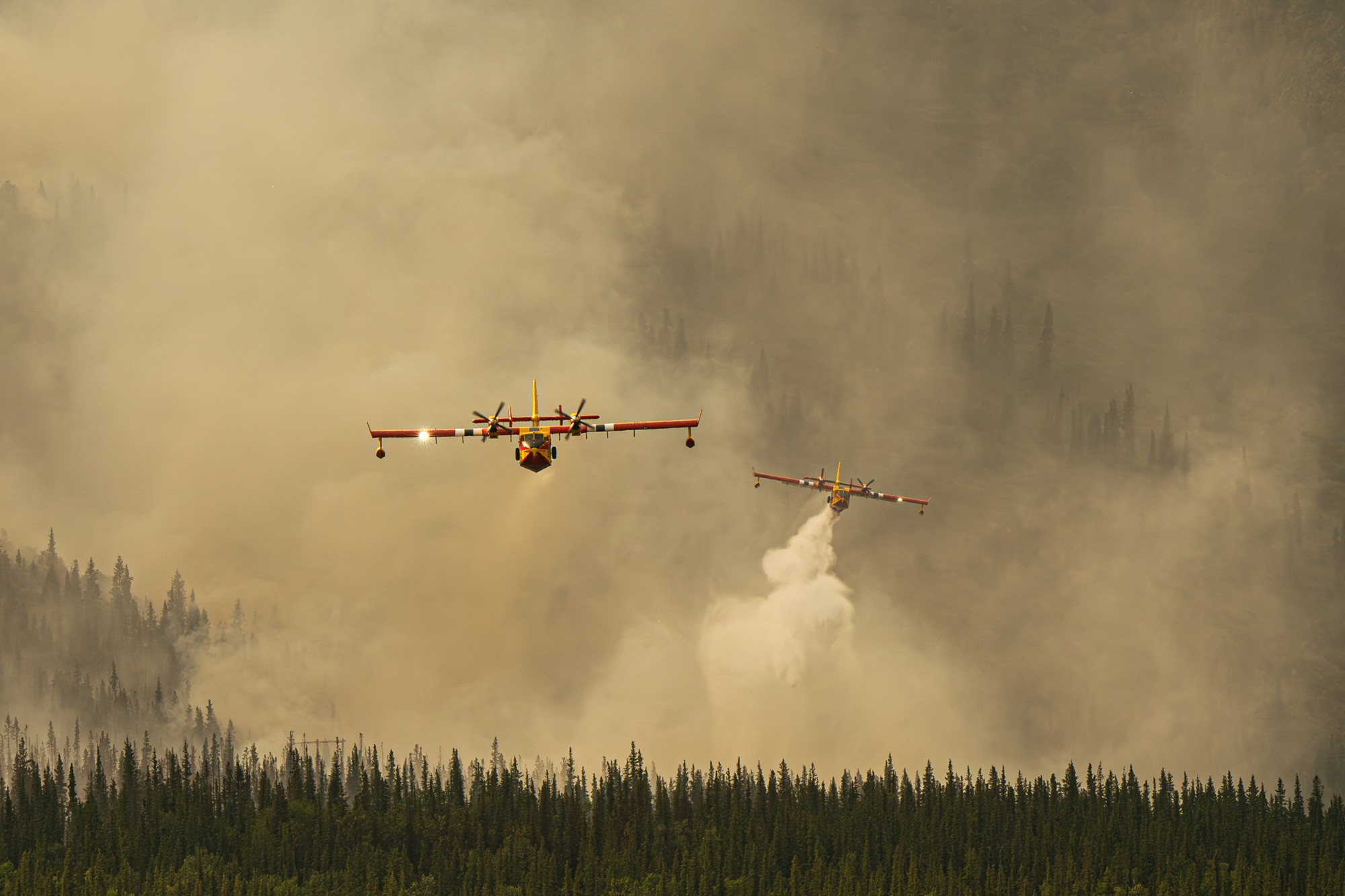
With FireFlyte, powered by TracPlus, Bridger Aerospace (Nasdaq: BAER) – one of the largest aerial firefighting companies in the US – builds an operational picture of every mission. That visibility lets the team analyze performance, sharpen tactics, and ensure every deployment does the most effective job protecting communities on the ground.
Auckland, New Zealand – 30 June 2026 – Knowing where a fire is burning is not the same as knowing whether the aircraft are hitting it effectively. Understanding how each aircraft performed – every drop, where, and when – is how aerial firefighting operators can focus on continuous improvement. Bridger Aerospace Group Holdings, Inc. has selected FireFlyte, powered by TracPlus, to produce this picture automatically across its fleet, just in time for the peak of the 2026 fire season.
Bridger holds some of the highest-profile federal aerial firefighting contracts in the United States. Performing well on contract demands more than just putting aircraft to work – it requires understanding what each aircraft accomplishes on every pass. Where did a Scooper drop relative to the fire perimeter and how did the sequence of drops track against how the fire moved? Without automatic data capture across the full fleet, questions are answered by estimation. Bridger demands better than that and this is what FireFlyte gives Bridger.
Each mission is recorded automatically – position, time, firefighting mode, drop lines, and an Aerial Firefighting Report generated for the work – from the moment an aircraft is airborne to the moment it lands. The data is captured once, at the source, rather than reconstructed afterwards.
“For Bridger, the goal is not just operational awareness, but also continuous improvement. Mission data from FireFlyte allows us to make sure every aircraft, on every fire, is performing at the highest possible level. Fireflyte also enhances our situational awareness so we can increase our focus on safe operations by using data to highlight trends and maintain our high tempo in the field. This visibility gives us the best possible data to perform our mission to protect what matters – lives, property, and the environment,” said Sam Davis, CEO, Bridger Aerospace.
The agreement covers Bridger’s fleet, including its six CL-415EAF Super Scoopers – amphibious aircraft that draw up to 1,412 gallons per pass – alongside the Air Attack and Multi-Mission aircraft, Pilatus PC-12s, King Air 350s and Daher Kodiaks equipped with imaging and infrared systems. FireFlyte brings all of them onto one operational picture, so a Super Scooper on a suppression run and an Air Attack aircraft providing overhead coordination appear in the same view, for pilots, ground coordinators, and agency partners alike.
“The industry is shifting toward automated, complete mission records. Agencies like CAL FIRE and Australia’s national program are already there. What’s changing now is that operators are making the same move. Bridger is leading that from the front. By capturing every mission automatically, the same way the major agencies do, they can focus on what they do best; flying the mission and keeping communities safe. That’s what we built TracPlus to do. We’re glad to be part of it,” said Todd O’Hara, CEO, TracPlus Global.
For more information, go to: www.tracplus.com
For more information, go to: www.bridgeraerospace.com
About the Author

This post was uploaded by Mark Seton.
- Mark Seton
- Mark Seton
- Mark Seton
- Mark Seton
- Mark Seton
- Mark Seton
- Mark Seton
- Mark Seton
- Mark Seton
- Mark Seton
- Mark Seton
- Mark Seton
- Mark Seton
- Mark Seton
- Mark Seton
- Mark Seton
- Mark Seton
- Mark Seton
- Mark Seton
- Mark Seton
- Mark Seton
- Mark Seton
- Mark Seton
- Mark Seton
- Mark Seton
- Mark Seton
- Mark Seton
- Mark Seton
- Mark Seton
- Mark Seton
- Mark Seton
- Mark Seton
- Mark Seton
- Mark Seton
- Mark Seton
- Mark Seton
- Mark Seton
- Mark Seton
- Mark Seton
- Mark Seton
- Mark Seton
- Mark Seton
- Mark Seton
- Mark Seton
- Mark Seton
- Mark Seton
- Mark Seton
- Mark Seton
- Mark Seton
- Mark Seton
- Mark Seton
- Mark Seton
- Mark Seton
- Mark Seton
- Mark Seton
- Mark Seton
- Mark Seton
- Mark Seton
- Mark Seton
- Mark Seton
- Mark Seton
- Mark Seton
- Mark Seton
- Mark Seton
- Mark Seton
- Mark Seton
- Mark Seton
- Mark Seton
- Mark Seton
- Mark Seton
- Mark Seton
- Mark Seton
- Mark Seton
- Mark Seton
- Mark Seton
- Mark Seton
- Mark Seton
- Mark Seton
- Mark Seton
- Mark Seton
- Mark Seton
- Mark Seton
- Mark Seton
- Mark Seton
- Mark Seton
- Mark Seton
- Mark Seton
- Mark Seton
- Mark Seton
- Mark Seton
- Mark Seton
- Mark Seton
- Mark Seton
- Mark Seton
- Mark Seton
- Mark Seton
- Mark Seton
- Mark Seton
- Mark Seton
- Mark Seton
- Mark Seton
- Mark Seton
- Mark Seton
- Mark Seton
- Mark Seton
- Mark Seton
- Mark Seton
- Mark Seton
- Mark Seton
- Mark Seton
- Mark Seton
- Mark Seton
- Mark Seton
- Mark Seton
- Mark Seton
- Mark Seton
- Mark Seton
- Mark Seton
- Mark Seton
- Mark Seton
- Mark Seton
- Mark Seton
- Mark Seton
- Mark Seton
- Mark Seton
- Mark Seton
- Mark Seton
- Mark Seton
- Mark Seton
- Mark Seton
- Mark Seton
- Mark Seton
- Mark Seton
- Mark Seton
- Mark Seton
- Mark Seton
- Mark Seton
- Mark Seton
- Mark Seton
- Mark Seton
- Mark Seton
- Mark Seton
- Mark Seton
- Mark Seton
- Mark Seton
- Mark Seton
- Mark Seton
- Mark Seton
- Mark Seton
- Mark Seton
- Mark Seton
- Mark Seton
- Mark Seton
- Mark Seton
- Mark Seton
- Mark Seton
- Mark Seton
- Mark Seton
- Mark Seton
- Mark Seton
- Mark Seton
- Mark Seton
- Mark Seton
- Mark Seton
- Mark Seton
- Mark Seton
- Mark Seton
- Mark Seton
- Mark Seton
- Mark Seton
- Mark Seton
- Mark Seton
- Mark Seton
- Mark Seton
- Mark Seton
- Mark Seton
- Mark Seton
- Mark Seton
- Mark Seton
- Mark Seton
- Mark Seton
- Mark Seton
- Mark Seton
