
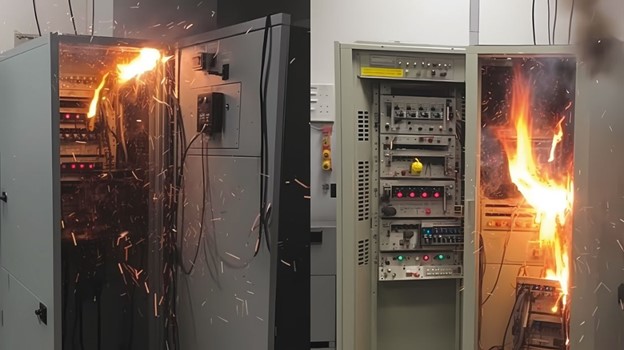
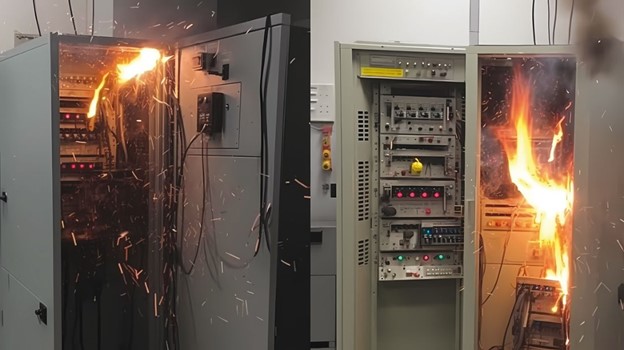
Kidde Australia continues to offer End Users a range of detection and suppression systems to suit their specific applications and environments. Exxfire offers detection and suppression in one unique package. In environments where high-value equipment—such as server racks, electrical switching cabinets, battery energy storage systems or telecom enclosures—are without fire suppression method: damage to sensitive electronics, high cost of re-installation, environmental concerns, and downtime are an unwanted risk. The ExxFire system presents an alternative detection and suppression technology specially designed for object-protection in small and medium enclosures.
How the ExxFire System Works
At its core, the ExxFire system uses a combination of advanced detection and a nitrogen-based inert gas suppression agent. Its operation can be summarised as follows:
- Early detection: The system uses aspirating smoke detection (or other detectors such as linear heat cables) to detect incipient fire conditions inside the enclosure.
- Cool gas generator: The system stores a solid chemical propellant inside a sealed generator unit, which, when triggered, decomposes to produce nitrogen gas. This is released at ambient temperature (no extreme cold or hot discharge) and low pressure (3-5 bar) into the enclosure.
- Inerting the enclosure: The released nitrogen displaces or dilutes oxygen in the protected volume, lowering the oxygen concentration to the point where combustion ceases.
- Minimal residue / cleanup: Because the agent is inert nitrogen (rather than a liquid or foam), there’s negligible residue left behind to clean up.
- Modular & scalable design: The system is designed for small enclosures, and units can be interconnected to protect larger volumes (up to 4.5 m³ or more by combining units).
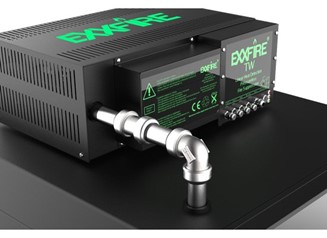

Here are some key advantages of using ExxFire systems.
1. Protection of Sensitive Equipment
Because ExxFire releases nitrogen at ambient temperature and low pressure, it is especially suitable for protecting electronics, data-centres, telecom gear and other sensitive hardware.
2. Minimal Downtime & Cleanup
With inert nitrogen as the extinguishing agent, there is no foam, no chemical residue requiring large cleanup, and no water damage. After activation there is less disruption to restore the protected environment.
3. Environmentally Friendly / PFAS-Free
ExxFire emphasises that its technology involves no PFAS-based agents, instead using inert nitrogen generated from solid propellant.
4. Safety in High-Value & Critical Applications
Because this system is designed for targeted “object protection” ExxFire is ideal for enclosures such as switchgear, ICT cabinets, battery racks, and the like.
5. Compact, Maintenance-Friendly, Flexible Installation
ExxFire is designed as “plug & play” format with consideration for flexible mounting options (inside cabinets, wall-mounted, or on top of racks).
The ExxFire technology represents a modern, clean, environmentally-conscious and equipment-friendly approach to fire protection for high-value enclosures. By using inert nitrogen released from a cool gas generator at low pressure, combined with advanced detection, it addresses many of the challenges of protecting sensitive electronics and mission-critical infrastructure.
To learn more, visit kidde.com.au or contact your local Kidde Australia sales representative.
Or connect with Kidde Australia on LinkedIn https://au.linkedin.com/company/kidde-australia
About the Author

This post was uploaded by Mark Seton.
- Mark Seton
- Mark Seton
- Mark Seton
- Mark Seton
- Mark Seton
- Mark Seton
- Mark Seton
- Mark Seton
- Mark Seton
- Mark Seton
- Mark Seton
- Mark Seton
- Mark Seton
- Mark Seton
- Mark Seton
- Mark Seton
- Mark Seton
- Mark Seton
- Mark Seton
- Mark Seton
- Mark Seton
- Mark Seton
- Mark Seton
- Mark Seton
- Mark Seton
- Mark Seton
- Mark Seton
- Mark Seton
- Mark Seton
- Mark Seton
- Mark Seton
- Mark Seton
- Mark Seton
- Mark Seton
- Mark Seton
- Mark Seton
- Mark Seton
- Mark Seton
- Mark Seton
- Mark Seton
- Mark Seton
- Mark Seton
- Mark Seton
- Mark Seton
- Mark Seton
- Mark Seton
- Mark Seton
- Mark Seton
- Mark Seton
- Mark Seton
- Mark Seton
- Mark Seton
- Mark Seton
- Mark Seton
- Mark Seton
- Mark Seton
- Mark Seton
- Mark Seton
- Mark Seton
- Mark Seton
- Mark Seton
- Mark Seton
- Mark Seton
- Mark Seton
- Mark Seton
- Mark Seton
- Mark Seton
- Mark Seton
- Mark Seton
- Mark Seton
- Mark Seton
- Mark Seton
- Mark Seton
- Mark Seton
- Mark Seton
- Mark Seton
- Mark Seton
- Mark Seton
- Mark Seton
- Mark Seton
- Mark Seton
- Mark Seton
- Mark Seton
- Mark Seton
- Mark Seton
- Mark Seton
- Mark Seton
- Mark Seton
- Mark Seton
- Mark Seton
- Mark Seton
- Mark Seton
- Mark Seton
- Mark Seton
- Mark Seton
- Mark Seton
- Mark Seton
- Mark Seton
- Mark Seton
- Mark Seton
- Mark Seton
- Mark Seton
- Mark Seton
- Mark Seton
- Mark Seton
- Mark Seton
- Mark Seton
- Mark Seton
- Mark Seton
- Mark Seton
- Mark Seton
- Mark Seton
- Mark Seton
- Mark Seton
- Mark Seton
- Mark Seton
- Mark Seton
- Mark Seton
- Mark Seton
- Mark Seton
- Mark Seton
- Mark Seton
- Mark Seton
- Mark Seton
- Mark Seton
- Mark Seton
- Mark Seton
- Mark Seton
- Mark Seton
- Mark Seton
- Mark Seton
- Mark Seton
- Mark Seton
- Mark Seton
- Mark Seton
- Mark Seton
- Mark Seton
- Mark Seton
- Mark Seton
- Mark Seton
- Mark Seton
- Mark Seton
- Mark Seton
- Mark Seton
- Mark Seton
- Mark Seton
- Mark Seton
- Mark Seton
- Mark Seton
- Mark Seton
- Mark Seton
- Mark Seton
- Mark Seton
- Mark Seton
- Mark Seton
- Mark Seton
- Mark Seton
- Mark Seton
- Mark Seton
- Mark Seton
- Mark Seton
- Mark Seton
- Mark Seton
- Mark Seton
- Mark Seton
- Mark Seton
- Mark Seton
- Mark Seton
- Mark Seton
- Mark Seton
- Mark Seton
- Mark Seton
- Mark Seton
- Mark Seton
- Mark Seton
- Mark Seton
- Mark Seton
- Mark Seton
- Mark Seton
- Mark Seton
- Mark Seton
- Mark Seton
