
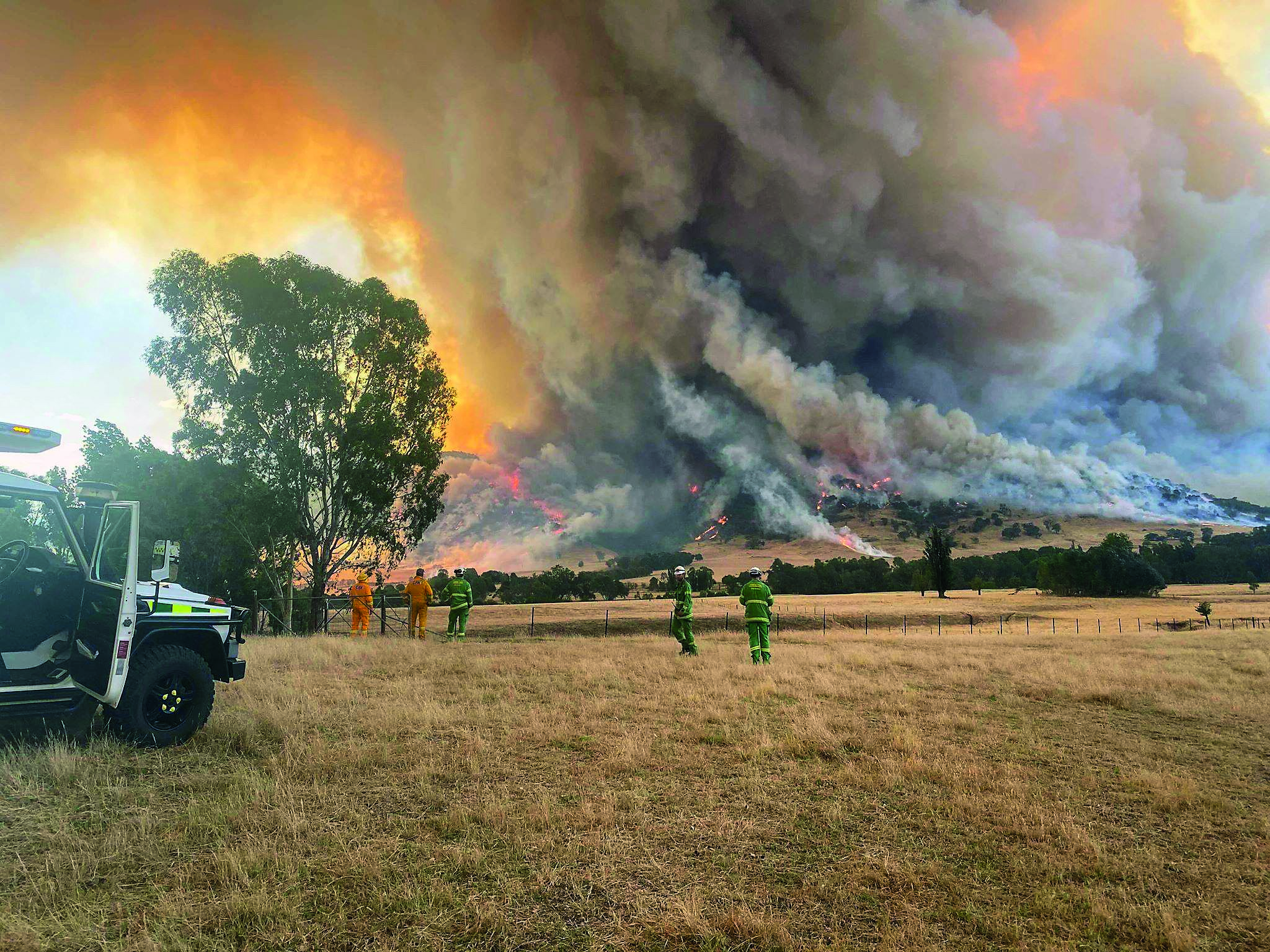
Australia has just been through its worst fire season with respect to areas burnt and although we had 34 deaths (including a number of firefighters) it could have been worse considering the size and length of the fire season. I see the relatively small death toll as a mark of pride for the Australian fire services. However, the size, intensity and disruption to the community is something not seen before in Australia.
This article is being penned in late February in order to meet the publication deadline for the April edition. There may be further fires this season. Nevertheless, I hope to give you a sense of what occurred in these large, unprecedented and protracted fires.
The usual fire season moves down from the tropics in northern Australia, starting in October and burning with low intensity through the wet tropics. Then the fires move down the western and eastern sides of Australia. I will concentrate on the east coast of Australia at this point because this is where the main fires occurred, and Australia’s main population density is located.
One of the factors leading into this fire season is a drought across most of Australia, it has been dry in Australia for two to three years depending on where you live. These particular fires really started in 2017 when drought reduced the moisture content of the land and undergrowth significantly, the pre-fire conditioning of the Australian Bush extended to the rainforests and this lack of rain (which in the past contained fires) resulted in fires going unimpeded.

These fires created huge damage across all states and territories in Australia: 34 people were killed, 2,779 homes were destroyed and 19 million hectares of forest and 1 billion animals have been destroyed in these fires from the driest ever 2018/19 drought to this year’s raging fires.
The first thing we should recognize is that we were warned.
The Garnaut Climate Change Review of 2008 stated, ‘recent projections of fire weather suggest that fire seasons will start earlier, end slightly later, and generally be more intense. This effect increases over time but should be directly observable by 2020’. (Professor Ross Garnaut, is a distinguished professor of economics at the Australian National University and both a vice-chancellor’s fellow and professorial fellow of economics at the University of Melbourne.)
To describe emerging fire trends, a study by Dr Chris Lucas and others defined two new fire weather categories: ‘very extreme’ and ‘catastrophic’.
The analysis by the Bushfire and Natural Hazards Cooperative Research Centre (CRC), the Australian Bureau of Meteorology (BoM) and CSIRO Marine and Atmospheric Research (as it was then) found that the number of ‘very high’ fire danger days generally increases 2–13% by 2020 for the lower estimates and 10–30% for the higher estimates. The number of ‘extreme’ fire danger days generally increases 5–25% by 2020 for the lower estimates and 15–65% for the higher estimates.
In April 2019 a group of former Australian fire-service chiefs warned that Australia was not prepared for the upcoming fire season. They called on the Prime Minister to meet the former emergency service leaders ‘who will outline, unconstrained by their former employers, how climate change risks are rapidly escalating’.
In August 2019 the Bushfire and Natural Hazards CRC published a seasonal outlook report which advised of ‘above normal fire potential’ for southern and southeast Queensland, the east coast areas of New South Wales and Victoria, parts of Western Australia and South Australia. In December 2019, the Bushfire and Natural Hazards CRC updated their advice of ‘above normal fire potential’.
I have only quoted a few, but there were others sending a clear warning that 2019/20 will be a bad year.
In September 2019 the BoM predicted at least three more months of drought as fires began in the north. September, October and November ended up being the driest spring on record.
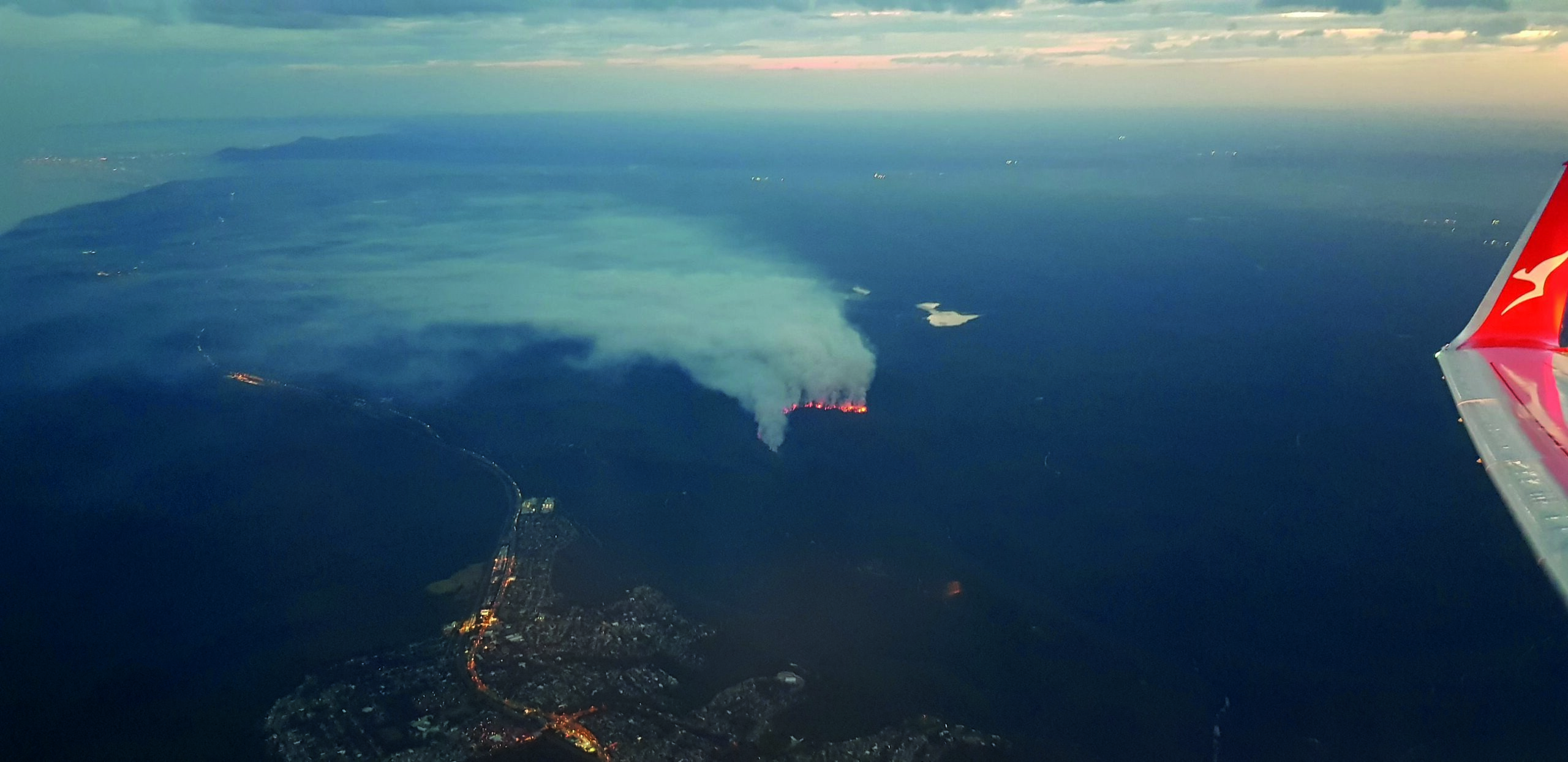
Queensland (Qld)
October was the official beginning of the Australian Fire season, but well before that Queensland was experiencing abnormal fire conditions. On 7 September 2019 multiple out-of-control blazes threatened townships across south-eastern and northern Queensland, destroying 19 homes. A large fire impacted the Peregian Beach area on the Sunshine Coast, on 9 September, severely damaging ten houses. In December 2019 Peregian Springs and the surrounding areas came under threat from bushfires for the second time in a couple of months. These fires were to continue across the state until mid-December.
On 13 November a water-bombing helicopter crashed while fighting the blazes threatening the small community of Pechey. While the Bell 214 helicopter was completely destroyed, the pilot walked away with minor injuries
One of the incredible features of the Queensland fires was the burning of rainforest, an ecosystem that does not see fire regularly and finds it hard to recover from burning.
These Queensland fires also saw the beginning of resource sharing across state boundaries. Many interstate volunteer firefighters assisted the tired Qld volunteers get through their horrendous start to Australian fire season. It should be pointed out that no sooner will the Qld fires finish than the northern cyclone season will begin, adding a burden to already tired volunteers.
New South Wales (NSW)
The State that took the brunt of this year’s extraordinary fire season was NSW. The NSW statutory Bush Fire Danger Period normally begins on 1 October and continues through until 31 March. In 2019–20, the fire season started early with drought affecting 95% of the state. Twelve local government areas started the Bush Fire Danger Period two months early, on 1 August 2019, and nine more started on 17 August 2019.
While Qld was coping with its fires the NSW fire season started with the first fire reported in July 2019, and as of 28 January 2020 this peat fire was still burning in a controlled manner, having been contained within a 592-hectare area near the Port Macquarie Airport.
From that July start, fires, mainly caused by dry lightning, continued causing death and destruction across the state. There are too many to list them all, but I will highlight some.
A large fire in November at Gospers Mountain in the Wollemi National Park burnt over 496,976 ha and threatened homes in the Hawkesbury and Lithgow areas. The fire burned towards the Central Coast and potentially threatened properties in Wisemans Ferry and other townships. By 27 December 2019, the Gospers Mountain fire had grown to 512,000 ha, making it the biggest forest fire in Australian history. On 10 February 2020, NSW Rural Fire Service announced that the past week’s torrential rain event had extinguished the Gospers Mountain fire, which had burnt for over four months.
The fires around Sydney highlighted what the NSW regional centres had been living with for months.
- Because of bushfires occurring in the surrounding regions, the Sydney metropolitan area suffered from dangerous smoke haze for several days throughout December and January, with the air quality being 11 times the hazardous level on some days, making it even worse than New Delhi’s. It was also compared to ‘smoking 32 cigarettes’ by Associate Professor Brian Oliver, a respiratory diseases scientist at the University of Technology Sydney.
- During the fire crises residents continually monitored the ABC, Australia’s emergency broadcaster. They needed continual updates on which to make their decision to stay or evacuate. The three main sources of information were, TV, radio and the ‘fires near me’ app. Although all technologies were used heavily across the state, with an exceptional ability to give up-to-date information, the most reliable source was the old-fashioned radio.
- Heat stress not only played a part in the rapid exhaustion of firefighters, Sydney Siders suffered through incredible heat. On 4 January 2020, Sydney’s western suburb Penrith recorded its hottest day on record at 48.9°C (120.0°F) making it the hottest place on earth at the time.
In the snowy mountains, a fire known as the Dunns road fire was ignited from lightning on 28 December. Residents and visitors to the Kosciuszko National Park were evacuated and the park was closed. However, this fire grew and by 11 January three fires had merged – the Dunns Road fire, the East Ournie Creek fire and the Riverina’s Green Valley fire – and had created a 600,000-hectare (1,482,632-acre) ‘mega-fire’, one of a number of mega-fires created by the coming together of large fires. This fire also took the lives of three American air crew when on 23 January their Lockheed C-130 Hercules large air tanker crashed near Cooma while waterbombing a blaze.

Victoria (Vic)
The Victorian fires commenced like many others from lightning strikes in east Gippsland on 21 November. The heat was so extreme in December that a two-day cricket tour match between a Victoria XI and New Zealand in Melbourne was cancelled due to the extreme conditions.
At the end of 2019 there were three active fires in East Gippsland with a combined area of more than 130,000 hectares. Fires reached the popular holiday town of Mallacoota on New Year’s Eve. Despite the recommendation that large portions of East Gippsland be evacuated, approximately 30,000 holiday makers chose to remain in the region. Approximately 4,000 people, including 3,000 tourists, remained in Mallacoota as the fire began making its closest approach to the town, cutting off roads in the process. The management of the fire was compounded by having to manage thousands of trapped holiday makers. On 3 January, with food in short supply, approximately 1,160 people from Mallacoota were evacuated on naval vessels HMAS Choules and MV Sycamore.
On 6 January 2020, bushfires had burnt through 1.2 million hectares (3 million acres) in Victoria’s east and north-east and 200 homes were confirmed lost; by 23 January there were 12 fires still burning. Heavy rain in the Melbourne region brought little relief to bushfire-affected regions. The rains could bring new dangers for firefighters, including landslides and falling trees.
Other states
Not wishing to play down the fires in other states, the enormity of this year’s fire season has made it difficult to do justice to all.
Tasmania’s bushfires commenced in late October and continued to burn in late January; 36,000 hectares were burnt out in total.
In Western Australia 2,200,000 hectares of bush were burnt. Luckily much was in isolated areas, but on 13 December increased temperatures resulted in fires burning in excess of 5,000 hectares, with the fire front over 1.5km in length. In December fires in the region around Norseman blocked access to the Eyre Highway and the Nullarbor. This caused the highways of the region to be blocked, isolating the west, so as to prevent any recurrence of the 2007 death of truck drivers on the Great Eastern Highway.
South Australia had 490,00 hectares destroyed, three fatalities and 151 homes engulfed in fire. On 20 December fires took hold in the Adelaide Hills. The fires killed one person and more than 70 houses were destroyed, as well as over 400 outbuildings and 200 cars. One of the South Australian Country Fire Service’s main problems was a fire on Kangaroo island in the Flinders Chase National Park, where a fire started in early January and engulfed one-third of the popular tourist island (170,000 hectares). The island is 150km long and 90km wide with a population of approximately 4,000 residents. This fire also destroyed critical wildlife habitat, which is the island’s main tourist attraction. Unfortunately, two people died in this fire.
The Australian Capital Territory (ACT) was not spared this season; fires in NSW cut the main links between Canberra and Sydney as well as creating smoke pollution over Canberra. On New Year’s Day the air quality in the capital was the worst of any city in the world, at around 23 times the threshold to be considered hazardous. Fires in the ACT burnt out 56,700 hectares and resulted in one fatality.
The Northern Territory went through a relatively average annual bushfire season with respect to area of land burnt, in comparison to the scale of bushfires experienced in other areas of Australia. Despite this, approximately 6.8 million hectares were burnt, an area which contributed significantly to the total area burnt by bushfires in the nation. Five homes were lost to bushfires in the Territory
This was a truly national event with a truly national response, and the mixing of uniforms from all over Australia resulted in those with the most needs getting the resources no matter what agency they belonged to.
International response
These fires took on a life of their own internationally. Through the coordination of the Australasian Fire and Emergency Service Authorities Council (AFAC), 12 countries provided much-needed assistance to the exhausted Australian firefighters. The countries were Canada, USA, New Zealand, France, Fiji, Japan, Malaysia, Singapore, Papua New Guinea, The Philippines, United Arab Emirates and Indonesia. Many other nations offered assistance.
Overall statistics
These fires started in August and are in some cases still being extinguished in late February. They utilized the following resources at the height of the season 3,000 firefighters, 1,500 trucks, 1,000 support staff, 143 aircraft including, but not limited to, very large air tankers, large air tankers, heavy rotary, medium rotary, air tractors and support aircraft. This is without including the military support, which was invaluable to the fire effort.
Environmental impact
There are three main issues to address here:
- Smoke: most of the east-coast population woke every day to the smell of smoke and on many occasions major and provincial cities had a smoke haze that became the worst recorded in the world. There is still much to be studied on the effects of smoke, but some predictions are that more people died as a result of the smoke pollution than as a direct result of the fires. In the smoke released as of 2 January 2020, NASA estimated that 306 million tonnes of CO2 had been emitted. While the carbon emitted by the fires would normally be reabsorbed by forest regrowth, this would take decades and might not happen at all if prolonged drought has damaged the ability of forests to fully regrow.
- Animals: it was estimated on 8 January 2020 that more than one billion wild animals were killed by bushfires in Australia, along with thousands of heads of stock in the farming community. These figures did not include frogs, insects, or other invertebrates. Ecologists feared some endangered species could be driven to extinction by the fires. On Kangaroo Island, a large part of the island is designated as a protected area for animals such as sea lions, penguins, kangaroos, koalas, pygmy possums and various birds including glossy black cockatoos. NASA estimated that the number of dead koalas could be as high as 25,000 or about half the total population of the species on the island.
- Water: most of these fires had direct and/or indirect interaction with the domestic water supply. After years of drought, all the water supplies were well below their danger levels. The best-case scenario was for strong summer rains in the catchment area to improve the dam level. The worst-case scenario has now come to fruition with heavy rain in mid-February washing debris and soot from the catchments into the dams. With the dams commencing at a very low level the normal process of dilution is not an option; authorities are monitoring the situation.
Leadership
In finishing I would like to pay tribute to the agency leaders; leading through a disaster like this is not an easy task. You must manage the disaster, politics, media and public while having long days and being ready for the inevitable issue coming out of left field. I would like to commend Commissioner Shane Fitzsimons NSW, acting Commissioner Mike Wassing Qld and Commissioner Andrew Crisp Vic.
I also acknowledge the political support from the premiers of these states: Gladys Berejiklan NSW, Annastacia Palaszczuk Qld and Daniel Andrews Vic
Conclusion
These fires were horrendous, unprecedented, unparalleled, extraordinary and whatever other adjective you care to use. Australia is not the only country in the world susceptible to wildfire. Unfortunately, with the globe’s temperature slowly increasing, this will become the norm until we get our climate back to an acceptable level and that means many decades of uncontrolled fires.
On a sobering note, the second cyclone in two weeks is about to hit Australia and it will be the same volunteers that fought the fires that will be preparing for the cyclone season.
For more information, email neil.bibby@apfmag.com
About the Author

Asia Pacific Fire, Editor
