
Since 2002, I have worked on fire, rescue and disaster-management projects in over 40 countries but never in Thailand. So, when the invitation came along to consider a project in Bangkok, I jumped at the opportunity. Little did I know this would be one of the more unique experiences I have been involved in so far in my colourful career.
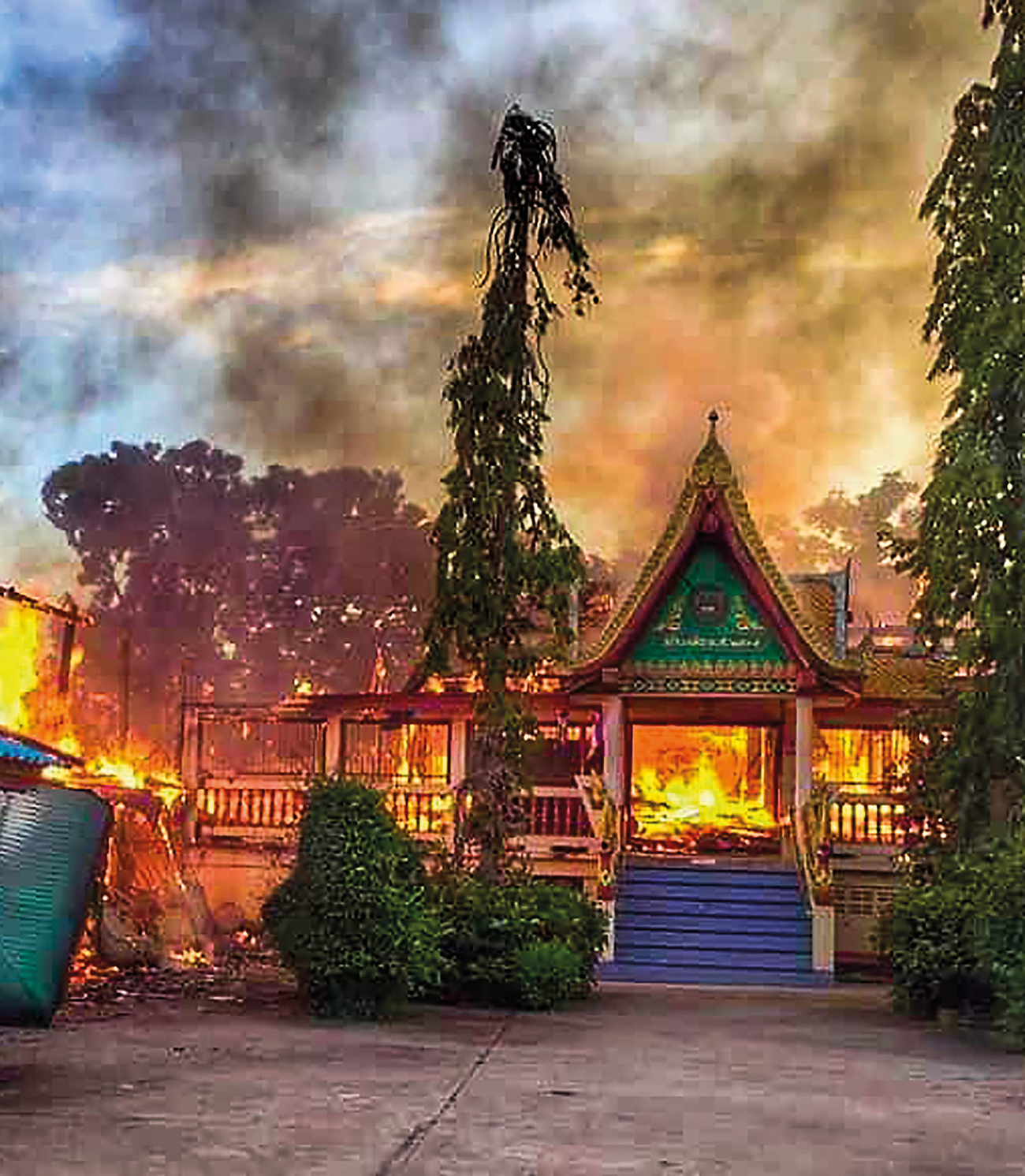
Ninety-five per cent of the Thai population are Buddhist and there are over 41,000 temples across the country. Many are centuries old and feature classical teak wood roof construction, decorated in a wide range of stunning designs. These places of worship are national treasures and centres of religious, historical and touristic importance with original architecture and artefacts that are irreplaceable. But the risk from fire is very high and they are all too frequently damaged or destroyed.
My hosts and project coordinators are two influential local businesswomen and parishioners who wanted someone to examine the problem in Thailand and make recommendations to improve it.
In many countries, places of religious significance are given special treatment by local emergency services to ensure that they are carefully protected. Officials develop and regularly inspect emergency plans to ensure that residents, visitors and first responders know what to do in the case of any natural or man-made disaster.
My task was to visit some of the most important temples in Bangkok, assess the general level of emergency preparedness and deliver a report and proposal based on the findings.
I was taken to Wat Pho, Wat Arun (think Notre Dame/St Paul’s Cathedral in national importance) plus three other large temples to give me a range of examples. Usually, a review and report take months to produce but not in this case as there was literally nothing in place at any of them.
Temple residents call local emergency services in the event of a fire, medical, or other event and simply wait for a response. Unfortunately, the efficiency of the Bangkok Fire and Rescue Department is also a concern and the organization in need of a complete overhaul.
There are no pre-planning or inspection programmes being carried out, hydrants at temple sites are either obsolete or non-existent, and access for emergency vehicles often impossible. The outcome is that most fires result in substantial damage, total loss of the property and sadly lives too.
So where to begin?
The project would need to look at both the Buddhist institution and their temples plus the agencies responsible for protecting them.
I was introduced to one of the most important and most esteemed monks in the country – The Venerable Phra Suthirattanabundhit (the Abbot of Suthiwararam temple) who has been campaigning nationally for improved safety in temples and recently published an introductory guide for prevention and protection from a wide range of natural and man-made disasters.
Thailand is no stranger to disaster having endured the Tsunami in 2004, severe forest fires annually, the incredible cave rescue of 13 boys in 2018 and, in October 2022, the worst mass school shooting in the country’s history.
His recommendation was to perform pilot projects in two of the most famous temples in Bangkok – Wat Molilokkayaram and Wat Arun and use them as examples to develop model SOPs and guidance, raise public awareness and get both the Buddhist administration and Thai government on board to stimulate nationwide replication of the scheme. But before any of that, I was advised to address the population on national television with an appearance on the ‘Buddhism for World Peace’ programme.
Normally I have no problem giving interviews with the help of interpreters, especially when the subject is fire, rescue or disaster related, but when I received the draft questions from the producers the night before the show on Religion, Temples, Thai Food, Covid-19 and world peace, I knew this would be a very different experience!
Upon arrival at the studio I was politely told that my suit and tie would have to be dispensed with and instead I was expected to wear a bespoke outfit that had been specially prepared for me that would be more appropriate for the viewing audience and earn me some credibility.
The show lasted an hour and after getting through the tricky cultural questions we finally moved on to my emergency service experience and the project itself. Once filming had finished, I expected to get changed and head back to the hotel but no, still dressed like a cross between George Harrison from the Beatles and Aladdin, the presenter and his team took me on an all-day tour of more religious and historical sites. I certainly got a lot of curious looks from members of the public.
The next week was spent meeting sponsors, senior Buddhist leaders, government officials, fire-industry specialists and the British Ambassador among others, researching the situation and explaining the process to all.
As with all GES projects, the approach is holistic and considers global best practice that could be relevant to the local conditions and only applying the most suitable solutions without cutting and pasting a specific set of standards. Guidance is being taken from specialists, examples and standards in India, Japan, the USA and UK. We will also be working with the Government Ministry of Culture and the Engineering Institute of Thailand.
Step one in early 2023 will be to conduct a comprehensive risk assessment and review of the Molilokkayaram temple. The security of this temple is especially important as it is a training school with over 600 resident monks and students, many of which are orphans who in return for refuge have dedicated their lives to religious learning. The Abbot of the temple is a personal spiritual adviser to King Maha Vajiralongkorn of Thailand (King Rama 10) and the institution receives personal support from the Royal family.
Following the review, a report will be published with results, findings and recommendations which will be the guide for improvement and the basis of developing an agreed emergency plan. The project scope is collaborative and will ensure that local government becomes a key actor in the process.
My team will coach and mentor municipal personnel on how to pre-plan, inspect and respond to various eventualities and is already leading into a wider discussion on the review and improvement of Fire/EMS providers in Bangkok and beyond.


The value of an emergency plan
Apart from the major benefit of providing clear guidance during an emergency, developing the plan has other advantages. It will help discover unrecognized hazardous conditions that could influence an emergency situation and work to eliminate them, such as: blocked emergency access routes by car parking, illegal sharing of electrical connections or blocked drains causing flooding.
The review will also identify deficiencies such as a lack of fixed equipment, training or policy that can be improved before an emergency occurs.
Fire safety is a challenge in temples because they were built in times without modern building regulations and it is difficult to adapt old structures to new rules. The subjects of automatic detection and suppression will be a balancing act to satisfy safety along with religious and architectural sensitivity.
An interesting component of the plan is that those expected to execute it are the monks who live and sleep on the property.


It will identify individuals appointed and trained to act as Emergency Coordinators with specific duties, responsibilities, authority and resources clearly defined. With municipal emergency service response neither immediate or guaranteed, to be successful, the plan will require monks to act as first responders which will be a delicate cultural task for some of the rough and ready training officers in my team!
Buddhist practice does not allow monks to come into any physical contact with females, even donations have to be placed on the floor instead of being handed over directly. But as part of the proposed first-aid protocols, Abbots have agreed that their monks can be permitted to conduct CPR and other medical actions on female visitors.
In addition to first aid, they will receive basic firefighting and rescue training to be able to use fixed and portable equipment which will be a historic challenge and amazing experience for everyone involved.
As Notre Dame, Windsor Castle and others have shown, even in developed nations accidents in historic buildings that are used 24/7 and visited by a growing number of tourists can occur, but pre-planning and a well-developed emergency plan will help to eliminate and mitigate many risks.
Thailand is a hypnotic country with warm, welcoming people, amazing food and a unique fusion of ancient and modern and it’s a privilege to be making a contribution to their heritage and public safety.
For more information, go to www.gannonemergency.com, www.gannonemergencyusa.com
About the Author

Chris Gannon has been involved in the FRS industry for almost 30 years and is recognised as a pioneer of international reform. He is the Managing Director of the Gannon Emergency Solutions Group with offices in the UK, USA and Latin America.
