

Although Thermal Imaging Cameras (TICs) can be used for size-up, unfortunately they are often underutilized for that purpose.
A high-resolution, decision-making camera with a fast refresh rate can enhance size-ups and our planning process. If used in addition to traditional standard procedures during a 360° size-up and ongoing assessment, the information gained can be essential in determining and monitoring the best strategy and tactics to ensure safe, effective and efficient fire-ground operations.
Thermal Imaging Camera (TIC) use for size-up at structure fires
We can gather sensory information such as what we can see, hear and feel. The additional use of the TIC allows us to ‘see’ through smoke and darkness and identify objects that can’t be distinguished visually allowing firefighters to identify key items and features. These can include such things as building layout, construction, access points, open windows and doors; people, utilities and hazards; and fire conditions including the seat and spread of fire, hidden fire in voids and potential for collapse. We can also determine the threat of radiant heat on nearby exposures and evaluate suppression efforts. Using the TIC may be more effective, efficient and provide greater safely without close contact and avoiding unnecessary exposure to hazards.
The TIC has a narrower Field of View (FOV) compared to what we can see visually. We should view and scan all sides of the building and ensure that our scan covers all of the roof, walls and even the immediate area at ground level around the building for hazards and other objects of interest.


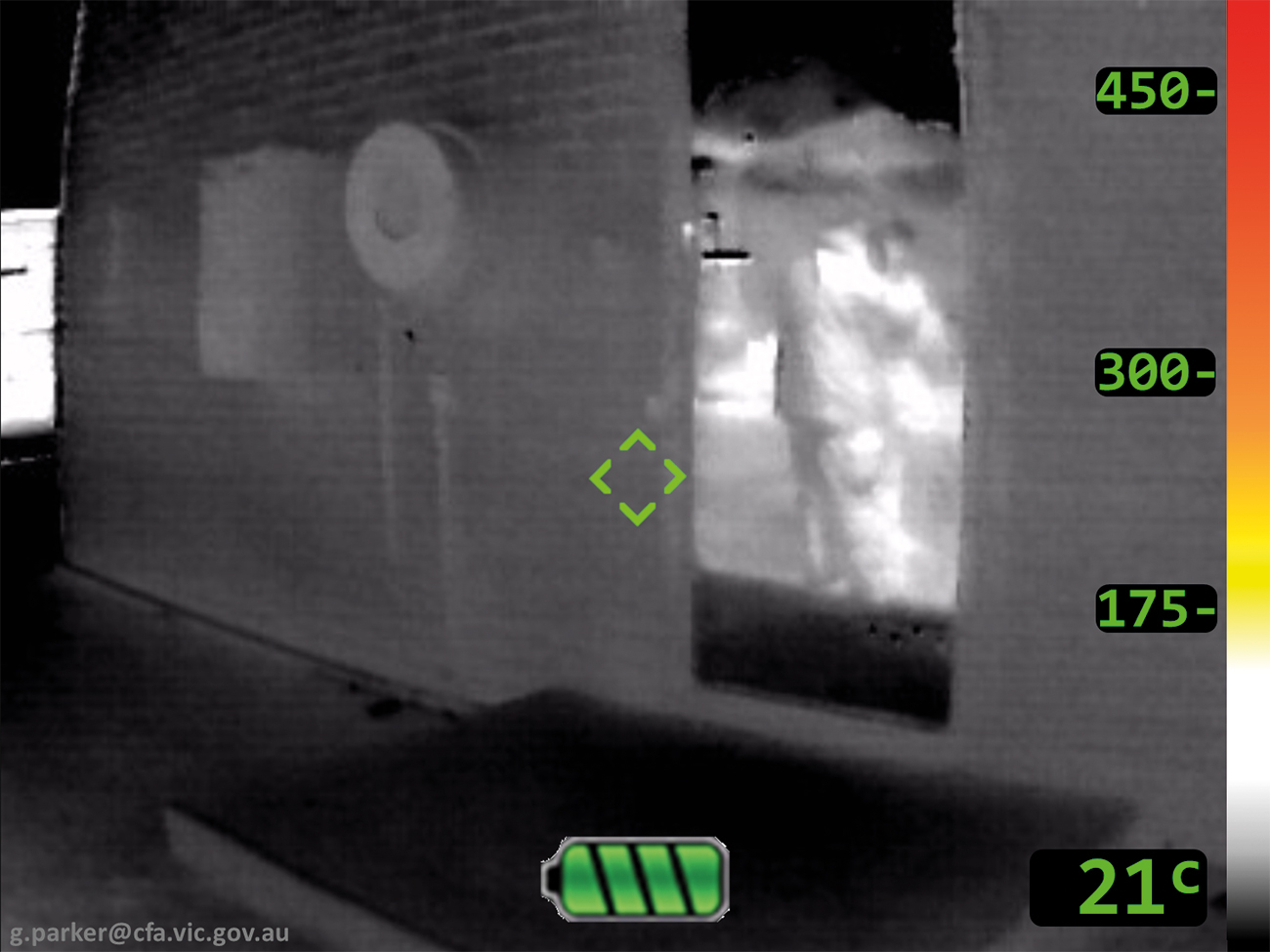
On initial assessment, although some heat transfer is apparent in the roof space and roof eaves on the home on the left, fire spread appears to be contained to the right side of the ‘firewall’. The potential origin, seat of the fire and its spread, as are points of possible access, can also be seen.
The thermal view and other information gained during further ongoing 360º size-up using both the TIC and traditional size-up methods will assist in determining the priorities and actions taken for both homes. Images supplied by Author / Contributor
Methods of heat transfer
Infrared (IR) energy is transferred by convection, conduction and radiation. Consider how energy will be transferred within and from the structure. This will largely depend on the thermal efficiency and conductivity of building components, convection within and from gaps and openings, radiant energy and the emissivity of surfaces.
Detecting heat, smoke, flames and identifying the location and spread of fire
Visually we may be able to see flames and identify smoke, its colour and behaviour. TICs detect surface energy and if used correctly can improve efficiency in identifying the seat and spread of the fire as well as fire conditions.
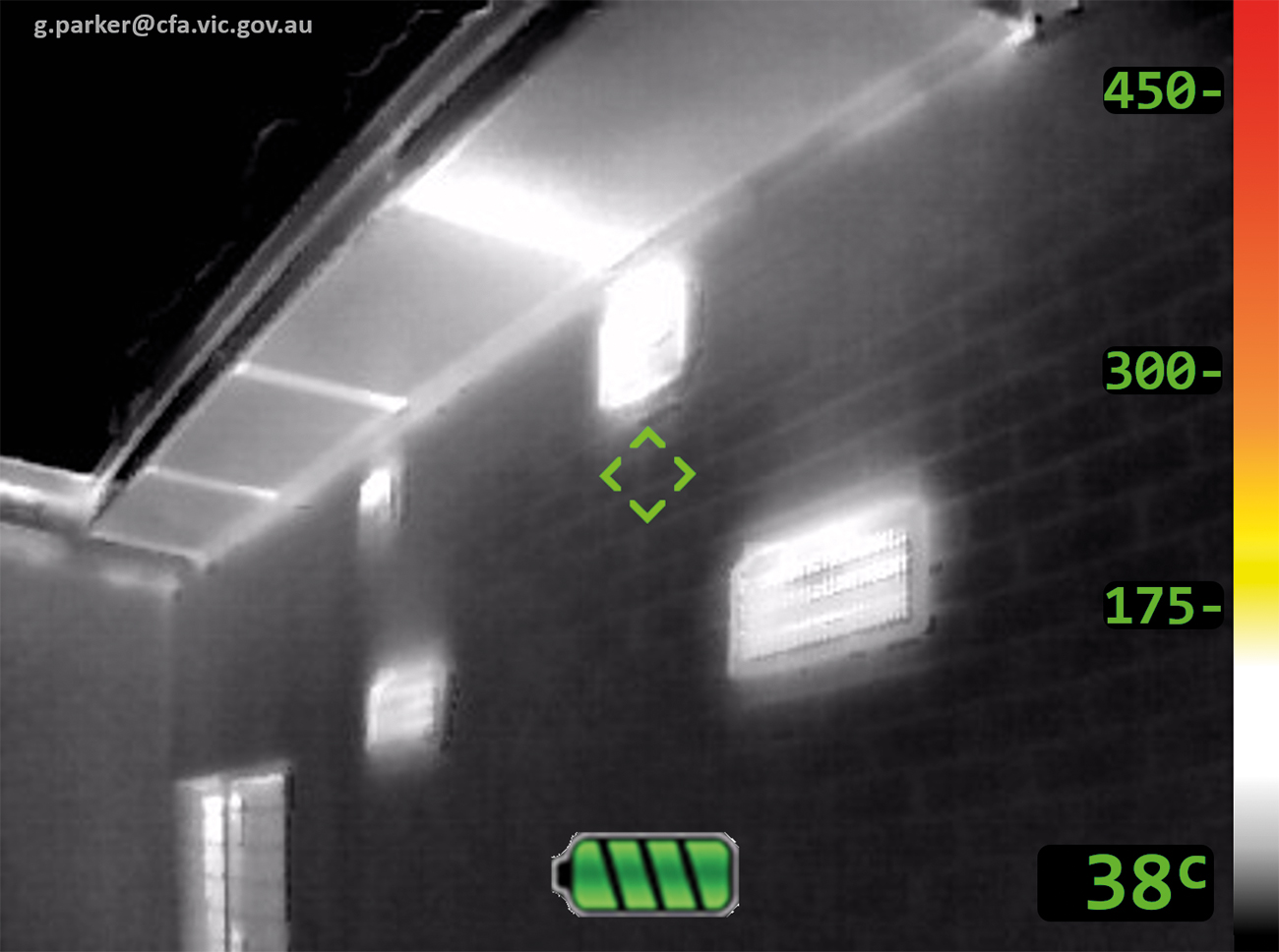
The TIC may identify the larger unburnt products of combustion and soot suspended in the convection flow. This flow may be laminar or turbulent. That together with the density, volume and velocity may indicate fire conditions. Convection energy absorbed by surfaces may also be identified near gaps, vents and other openings. The conductivity of materials, temperature difference, distance or cross-sectional area, together with exposure time are factors affecting the rate of heat transfer by conduction to outside surfaces. IR is emitted from all objects; the hotter an object is, the more energy it emits. Any area where heat loss or transfer can be expected may provide early indicators of abnormal heat and fire conditions, these can include such things as vents, roof eaves, joints, flashing, windows and doors.

Building materials
Consideration needs to be given to the emissivity of surface finishes. While the integrity of the surface finish is in place, a low emissivity or shiny surface may reflect background IR energy and provide inaccurate temperature indications. This may occur on surfaces such as galvanised, polished or painted metal finishes for example.
Building materials and their arrangement will provide different rates of heat transfer or conductivity to external surfaces. The materials used may vary between residential, commercial and industrial buildings. Different building methods and designs should also be factored into your assessment.
Windows and glazing can be heated from energy inside the structure indicating fire conditions. Glazing can vary in thickness and construction including single, double and triple glazing. IR will be reflected by glass so we can’t ‘see’ inside the structure as we may be able to visually.
Roofing materials and wall claddings together with any internal insulation can vary greatly, and these can affect heat transfer rates, conduction and heat loss by convection. Vents, skylights, joints and seals may compromise the insulating integrity of the building and provide early identification of energy from inside the building. This may be evident around door seals, window joints, roof flashing and vents. Fire extension and convection energy through ceilings and insulation can allow high levels of convection energy to enter roof spaces.
Doors can vary from household and personal access doors to larger doors used for vehicle access, loading bays and other openings. These may provide gaps for the escape of convection gasses. The insulating properties and heat transfer rates on many doors and their frames may be different to wall claddings and materials.

Key factors in using a TIC for structure fire size-up
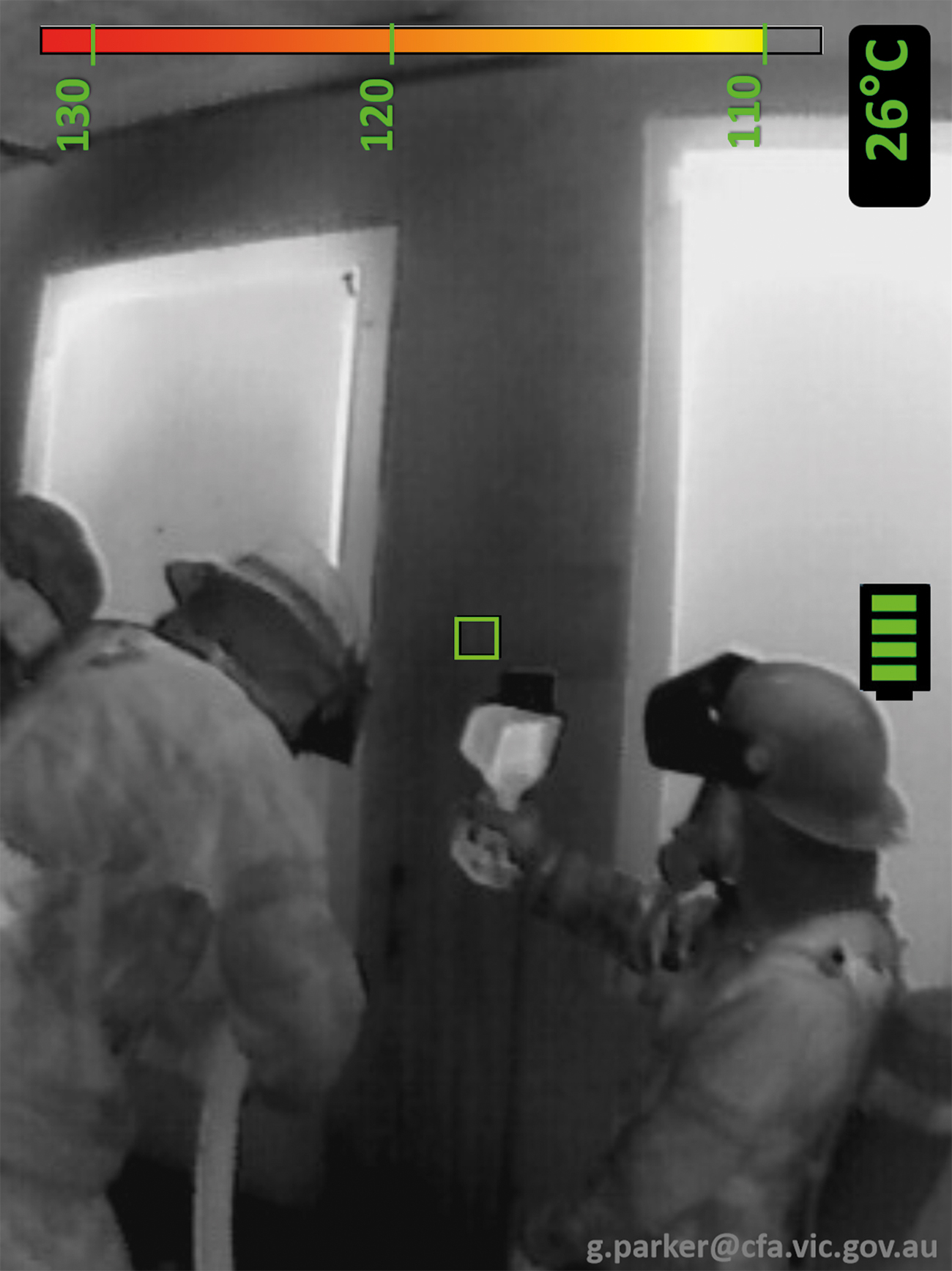
Initially there may only be one TIC available. Ideally the camera should be used by the incident controller for the initial size-up while the crew is making equipment ready before entry or other tasks.
TICs can be used for continued size-up and assessment of conditions throughout the firefighting operations. However, if only one TIC is accessible, it may be more advantageous following the initial size-up to use that camera in roles such as search and rescue or fire attack until another one is available.
The ability to understand and identify the shift point from high to low sensitivity in standard mode as well as the corresponding temperature ‘kick-in points’ for screen colorization will assist in rapid and accurate assessment of heat conditions.
Limitations
- FOV, camera modes, sensor and spatial resolution may vary depending on the type of TIC that is being used and may affect the image quality and detail that is displayed.
- A slow sensor refresh rate may reduce the speed that the camera can be panned to view a scene.
- Analysing the scene by the apparent temperature of objects alone will be far more efficient than utilising direct temperature measurement. Know the temperature “kick in points” for colorization for the camera’s sensitivity modes.
- Building construction features and materials may play a huge role in indicating or hiding the effects of fire and the transfer of heat.
- Consider the effects of background energy, weather and environmental factors such as rain, wind and the sun’s energy on the building.
- Anomalies may be a result of activities within the building such as normal heating or manufacturing processes. These and other factors may give a false indication of conditions that could be mistaken for fire or fire spread.
Conclusion
The effectiveness of a size-up can determine the success of firefighting operations. By using thermal imagers early at structure fires for size-up, incident controllers can gain additional information that may not have otherwise been available.
It must be remembered that a TIC does not “see” through solid objects. It identifies surface temperatures. This is especially important to remember when evaluating structures and internal fire conditions.
Firefighters cannot rely on the TIC as their only means of size-up. TICs have two-dimensional view, limited depth perception and FOV. Always compare what can be identified visually, heard and felt. In all cases standard procedures must be used to ensure that safety is maintained and a complete and thorough size-up has been undertaken. A TIC should only be used as an additional aid to those standard practices and procedures.
For more information, email G.Parker@cfa.vic.gov.au
About the Author

I joined Country Fire Authority (CFA) as a volunteer member of at the age of 16 in 1976 and commenced a full time career with CFA in January 1995. I have been working in the Latrobe Valley since 2000 and since that time have attended numerous fires and incidents in the power industry including several significant mine fires and currently working as a Senior Station Officer at the Traralgon Fire Station on D Platoon. Apart from my normal duties I have had a long term interest in firefighting aircraft operations, thermal imaging and the coal industry.
