
Foam based fire protection systems play a vital role in the protection of life, property and business in a wide range of processing, manufacturing and storage involving Class B ignitable liquids. Fire-fighting foams contain fluorinated surfactants and are chemicals known as PFAS (Perfluoroalkyl and Polyfluoroalkyl Substances).
In firefighting and fire-protection systems, PFAS helps to increase the speed of the foam coverage and make the bubble structure more resistant to fire and heat. This is vital not only for the fast and effective extinguishment of the fire but, most importantly, to maintain post-fire stability to prevent re-ignition. PFOS (Perfluorooctane Acid) and PFOA (Perfluorooctanoic Acid) were commonly used in fire protection foam concentrate formulations (C8 foam) and are sub-chemicals belonging to the group of PFAS. C6 foams contain Perfluorohexanoic acid (PFHxA), which is a member of the PFAS group of substances.
Are these foams biodegradable?
Readily biodegradable is defined as the ability of a product to biodegrade quickly and completely (≥60% by OECD 301A-F/ASTM D7373 testing) within 28 days. Readily biodegradable products are environmentally preferable.
Many current fluorinated foams (C6) meet this requirement and are therefore considered biodegradable. However, this does not imply or confirm they are 100% biodegradable. Fluorinated foams cannot degrade to 100% as they will leave the fluorinated surfactants (PFAS) behind.
So, what’s the problem?
Since the 1940s, PFAS has been used in many industries to improve strength, resistance and performance of products such as non-stick pans, stain-resistant fabrics or fire-resistant clothing. PFOA and PFOS have been the most extensively produced and studied of these chemicals. Both chemicals have shown to be very persistent both in the environment and in the human body and can accumulate over time.
PFAS are commonly referred to as forever chemicals. They have the potential to pose health and environmental concerns as they do not break down easily and can remain in the environment and human body for a long time. Such chemicals are referred to as Persistent Organic Pollutants (POP) under the Stockholm Convention which was adopted in 2001 and enforced in 2004 in response to global concerns with certain chemicals.
The Stockholm Convention (adopted in 2001) is a global treaty to protect human health and the environment from chemicals that:
• remain intact in the environment for long periods
• become widely distributed geographically
• accumulate in the fatty tissue of humans and wildlife
• have harmful impacts on human health or on the environment.
The treaty requires its parties to take measures to eliminate or reduce the release of POPs into the environment. In May 2019 PFOA was added to the list, thus impacting the use of C8 Foams
What’s trending
A quick timeline on legislation
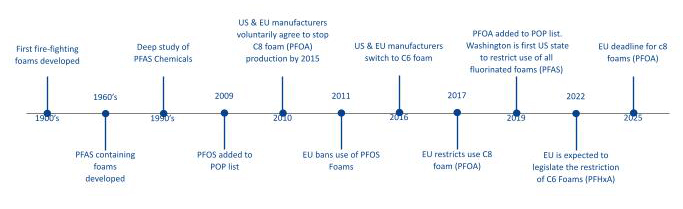
Over the last three years legislative changes regarding the use of fluorinated firefighting foam have reached critical mass in several regions around the world. With the deadlines restricting the use of PFAS (Per- and polyfluoroalkyl substances) containing foam in parts of North America and the European Union looming, end users are feeling the pressure to transition their firefighting and fire-suppression systems to fluorine-free foams to ensure compliance.
While some sectors such as aviation and oil refining in these regions are ahead of the curve, other sectors such as manufacturing and logistics are slower to recognise the future legislative and environmental impacts. PFOA (C8 Foams) is regulated internationally as a POP (Persistent Organic Pollutant) by the Stockholm Convention and the restriction applies to all 185 participating countries.
Three documents from the EU provide the legislation guidelines in Europe relating to PFOA (C8):
- EU 2017/1000, is the initial legal document that restricts the production, use and emission of PFOA.
- Commission Delegated Regulation 2020/784, defines PFOA as a POP and specific restrictions apply to C8 foams.
- EU 2019/1021, limits the stockpiling of PFOA (mandatory declaration to the local authorities for 50 kg minimum)
The restrictions in Europe were previously based on the type of PFAS (e.g. PFOS, PFHxA). However, proposed legislation set to be implemented in 2023 will cover all PFAS and targets firefighting foams specifically with a transition period of five years. As such, several national environment agencies across Europe have released notices and guidelines accordingly.
Legislation in America is driven by the individual states and the situation is constantly changing. According to the website, saferstates.com, there are 213 current policies being considered in 31 US states and 102 adopted policies in 23 states that relates to PFAS as of 2 November 2022. It is worth noting that not all of these are related to firefighting foams.

Developmental challenges
As a consequence, codes and standards from various established agencies have created specific definitions for these alternatives that do not contain fluorinated surfactants.
In May 2021, Factory Mutual (FM) revised their May 2021 edition of FM5130 to include the definition ‘A foam produced from a synthetic concentrate which excludes any fluorinated surfactants other than trace elements’. In that same year the National Fire Prevention Association updated Chapter 11 to include ‘Foam concentrate based on a mixture of hydrocarbon surface active agents that is not formulated to contain per- or polyfluoroalkyl substances (PFAS)’.
In January 2022, United Laboratories followed suit, adding to their UL 162: ‘A foam liquid concentrate that has a base other than fluorinated surfactant or hydrolysed protein; and shall be formulated such that it does not contain intentionally added per- and/or poly-fluorinated substances (“PFAS”)’. All the definitions recognise that trace elements of PFAS can occur outside of the formulation and manufacturing process. These definitions give rise to the name Synthetic Fluorine Free Foam (SFFF).
Fluorinated foams were developed in the 1960s and in the span of 60 years, there been countless tests and there is now a wealth of information we know about the performance of C8 and C6 foams. SFFF on the other hand, is relatively new with different chemistry. As such, the codes and standards have provisions for greater allowances when it comes to testing of SFFF but require higher application rates in the final approval.
In comparison to C6 foam, SFFF’s performance require a higher application rate in some instances. Due to test standard protocol differences, the safety margin and fire performance are closer to the limit. Drainage times are longer with SFFF, which means that the foam blanket remains longer, meaning re-application of foam can often be delayed. SFFFs typically increased aspiration to maintain performance. This can mean a requirement for specialist nozzles, higher discharge pressures or specific formulations.
With these challenges in mind, it is vital to obtain approvals/listings as a complete system, on top of the approvals/listings of the individual components/products. The obvious purpose is to ensure that the system as a whole will perform as it should in fire scenarios.
In reality, the demand for Approved/Listed SFFF systems is moving faster than manufacturers can bring high-performing products with important attributes to market. Replacing fluorinated foam with SFFF foam system approval is complicated as it involves testing a complete system, which takes time and can be expensive.
The solution is here
In late 2021 VIKING launched a unique SFFF product. Viking ARK was developed and tested in combination with a selection of VIKING products (sprinklers, proportioning devices, etc.) to obtain Approvals/Listings as a system. This achievement is the culmination of many years of dedicated research, development and testing, focused on the performance of these foam systems as a whole.
VIKING ARK is an alcohol-resistant fluorine-free foam concentrate. VIKING ARK is the first SFFF in the industry to obtain FM Approval for use on Hydrocarbon and Polar Solvent ignitable liquids. Its particular strength is in the huge range of testing and Approvals with non-aspirated sprinklers of many types and with several different fuels. Viking ARK is ideal for applications involving manufacturing/processing and warehousing of ignitable liquids. VIKING ARK SFFF System is the typical alternative to fluorinated ARC3x3 C6 Foam Systems.
In late 2022, VIKING USP was introduced. VIKING USP is designed for use with hydrocarbon risks and carries a wide range of approvals/listings such as FM, UL, EN1568-3, IMO Misc 132, ICAO Level B and Boeing corrosion standard BSS 7432. VIKING USP has the potential to replace fluorinated AFFF 3% C6 foam systems.
Both the VIKING ARK and VIKING USP are primarily proportioned at 3% in fixed systems and have been tested extensively by FM Approved for use in Bladder Tank Proportioning Systems. They can also be proportioned with water turbine pumps and traditional foam pumps.
For more information, please contact VIKING at vikingapac@vikingcorp.com
About the Author

Simon Barratt is the Foam Product Manager for Viking EMEA. With over 24 years of Fire Protection experience, Simon is responsible for the foam product line development and certification of Viking’s expanding line of fixed fire protection Foam Products.