
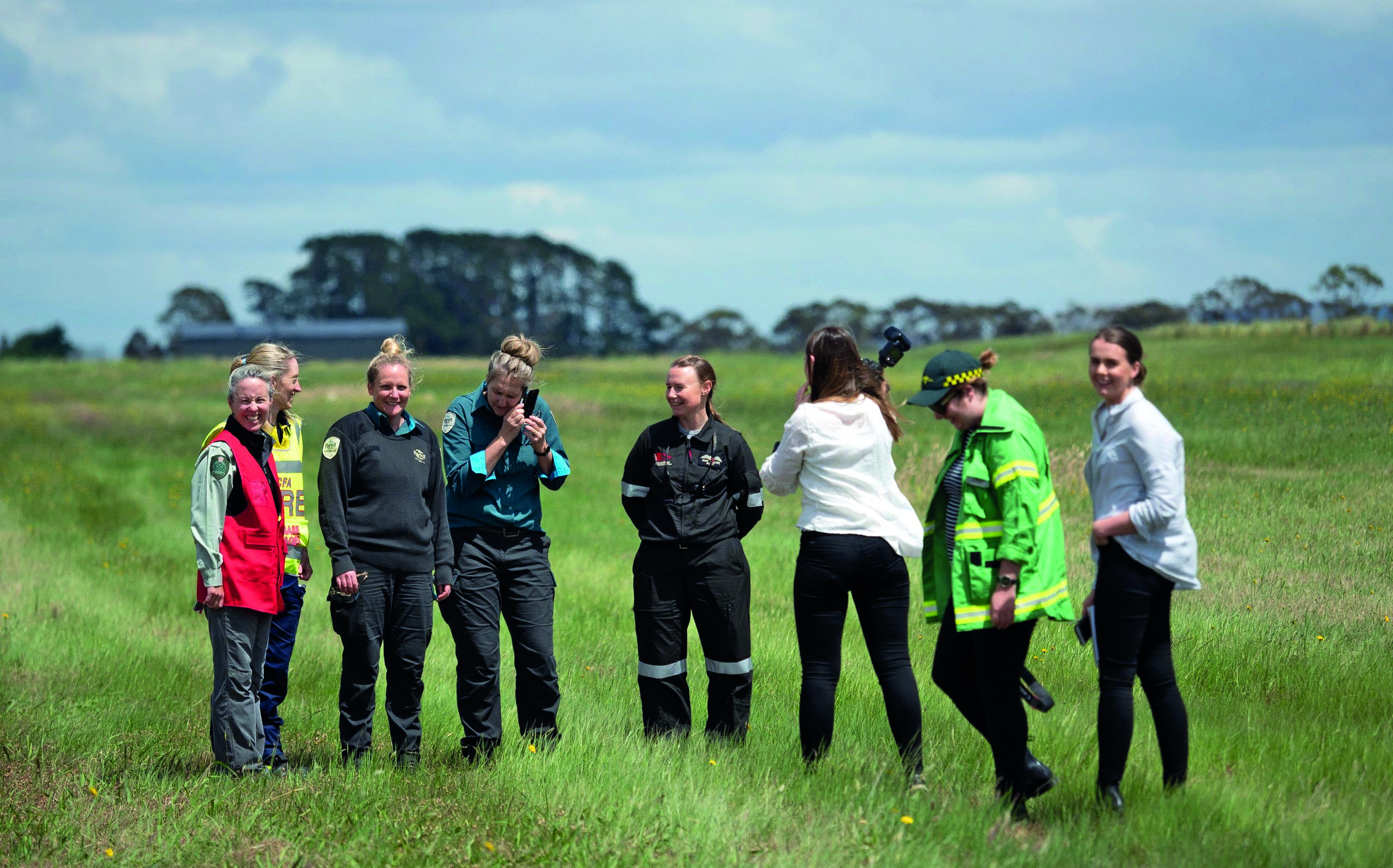
The disparity in gender within the aviation sector tells its own story. In Victoria’s emergency response agencies the low statistics of women have remained low for the past five years. At the end of 2018 of the 282 aviation accredited agency staff in the state, only 15 were women.1
Regardless of a 15% increase in accredited staff over the past seven years the participation of women decreased over this same period. I want to highlight the barriers but more importantly explore how inclusion can be achieved and start the conversation about what the ‘new norm’ could look like.
The emergency management sector holistically is taking great steps forward in diversity and inclusion with action plans and strategies across all agencies, but the aviation sector seems to be lagging in the new movement. The barriers are the same as for our fire and emergency operational female colleagues but harder to navigate, the buy in for change is a challenging task as we are segmented by rigid pathways for progression and accreditations. We need to collectively challenge the current systems and build a stronger, more inclusive and diverse future. This paper will identify and discuss methods to address issues that inhibit inclusion in emergency management aviation capability.
If he can do it #SoCanShe
Gender diversity
While diversity is fundamental, gender equality is paramount. Equality is achieved through access to the same resources, rewards and opportunities. With the current status of airborne accreditations and pathways it will take years before women achieve any meaningful representation in the ‘upper levels’ of the aviation sector.
Organisations that respect the value brought by both women and men are more likely to attract and retain high performers and improve their operational performance. Diversity brings about varied perspectives, provides a more holistic analysis of issues and leads to improved decision-making.2
The challenge is to close the gap, and to do this you need to know how big it is and what is causing it.
The beginning
Women have been part of the aviation world since its inception in 1908 and within two decades every continent except Antarctica had female pilots. What was interesting is they participated in aviation across a whole range of areas including aerial shows, parachuting and air races.
Bettie Lund watched her husband and flying partner crash to his death in 1932 and not long after stepped in to take his place in an air show. What is interesting about Bettie is that she took to the air to ‘convince people that flying was a safe means of transportation and that women made good pilots’.
Laura Ingalls performed 714 barrel rolls in a row on May 8, 1930 absolutely smashing the men’s record of 417.
During this time they weren’t the only women – Australia’s own Nancy Bird, known as the ‘Angel of the Outback’, Amelia Earhart, air racer Phoebe Omlie, record breaker Jacqueline Cochran and dozens of other amazing women became symbols of a new era of aviation in the 1930s.
So these incredibly brave women paved the way, in a time where it was deemed the domestic role was the ‘proper and fulfilling role for women’.
Currently, India has a global high of 13% female pilots with double this number attending flight schools. India has experienced a rapid growth in domestic air travel of 22%, which made it the fastest growing aviation market in the world creating a high demand. However, what attracted women into the industry is that the pilot profession is one of just a few in India without a gender pay gap. Since pilot pay is based on a combination of flying hours and seniority, it is harder for gender bias to seep through.3
So, with trailblazing women in the 1930s and the women of India leading the way it begs the question: why, in 2019 are we not engaging women in the fire and emergency aviation sector?
Exploring the challenges
Pathways
The pathways for airborne roles in the aviation sector are based on operational progression so this represents a challenge from the onset with low numbers of women in the operational areas. If we look at the success in India, one of the driving factors is the clear parameters for all pilots; it is a predetermined pathway with equal rewards – this has drawn women into the industry at a rapid rate.
Currently, in the emergency sector pre-requisites for some aviation roles differ and in some instances are unclear. The State Aviation Coordinator is yet to have a defined pathway and the role of Air Operations Manager is different in Victoria to the rest of the country.
We need to challenge the relevance of the required standards, provide clarity around pathways and develop clear strategies for women to progress.
Culture
Ambition is influenced by culture, and ultimately both women and men will excel in an environment that actively values diversity and has a positive culture.4 The aviation sector is not unlike the general fire and emergency space with a dominant masculine culture.
Unconscious bias plays into culture and its prevalence is evident in low representation of women in not only aviation accredited roles but the inclusion of those women in areas of influence and decision-making opportunities such as strategic planning, training delivery and operational meetings.
This year Aircraft Officer and Air Attack Supervisor training was delivered by all males with only one female participant, despite there being female aviation trainers and assessors. Victoria does not have a female Air Attack Supervisor and only two female Air Observers, who were only recently trained. Although there may be traction in agencies for retention of women, inclusion is not yet being achieved.
Now is the opportunity to leverage diversity to innovate and transform the sector, disrupt the norm and lead the way in modelling what is valued.
Visible role models
Visible role models are integral to women’s participation and aspirations. A great example is the Otway Fire District, my home district, where there are currently six women performing aviation roles. This is over a third of the state’s accredited women! With minimal effort we have led change purely by ‘doing the role’. It is a powerful example of ‘you can’t be what you can’t see’ or in our situation ‘you CAN be what you CAN see’. Women see a female performing the role and they believe it is achievable. And it is.
Visible female role models are also critical for men – men see women effectively performing a role and their perceptions change, their thought processes change.
Women need to be engaged, give them a seat at the table. Let them influence our way forward.
Start the conversation
Special measures
Setting clear, quantifiable goals is the most transparent and definitive path for change. Quotas and special measures, although controversial, have proven successful for the achievement of increased participation and may initiate the presence of women at ‘upper levels’ of the aviation sector.
In 2016 Melbourne Fire Brigade created a recruitment campaign which involved a targeted social media advertising campaign to encourage women to apply; this resulted in 350 male and 290 female applicants. New South Wales SES created ‘Get Ready Girl’ – a series of workshops conducted by women for women to improve participation.
The key to meaningful and successful change is metrics – set measures through goals and targets, measure the progress, measure the success.
Authentic leadership
We have moved into a new age of leadership – empathy, listening, emotional intelligence. This is an exciting time as authentic leaders can more readily engage and inspire, which can drive transformation and take followers along with them. Jacinda Ardern, Prime Minister of New Zealand, is the epitome of the new-age leader. She was not expected to win her election, she entered the race late with radical ideas, but she swept the nation and is now one of the most inspirational leaders on the world stage.
In Victoria the agencies and their leaders need to work together to tackle the barriers and challenge the status quo, take a risk – mandate change, create a shift to the new norm – get on board the movement that is gender diversity.
Disrupt the norm
Put gender on the agenda in the aviation sector; disrupt the status quo. Challenge the basic assumptions about strategies, operations, practices and procedures. Diversity goes beyond increasing the number of women in the sector, diversity should be understood as the varied perspectives and approaches to work that women bring.5
The future of emergency management places community at the centre. If we are going to be effective emergency managers, the makeup of our agencies must reflect the makeup of the communities we serve. Gender diversity is not simply about having numbers of women in your organisation, it is the representation of women across all roles in ALL areas of emergency management.
Women and men need to be empowered to drive change and start the movement, be brave, be supported to call it out. Behaviour change is a massive undertaking; confronting unconscious bias and stereotyping is one way to start the process, but women also need to put their hands up – if you are offered an opportunity because you are a woman – take it. Break the ceiling, others will follow.
For more information, go to www.parks.vic.gov.au
References
- Source: Emergency Management Common Operating Picture (EM-cop), latest statistics available
- Bring your Lipstick (AFAC Paper 2015) Ariana Henderson/Sandra Robinson
- You’ll never guess who has the most female pilots – https://www.forbes.com/sites/bishopjordan/2018/09/12/female-pilots-india/#789562a3469d
- Dispelling the myths of the gender ambition gap. Source https://www.bcg.com/en-au/publications/2017/people-organization-leadership-change-dispelling-the-myths-of-the-gender-ambition-gap.aspx
- Cross Cultural Management – Making differences matter: a new paradigm for managing diversity
About the Author

Sandra Robinson, Aviation Coordinator, Parks Victoria, Fire and Emergency Services.
