

The impact of climate change and the high-level humidity in Singapore will inevitably induce greater physiological strain on the general population and even more so for the local emergency responders who carry heavy loads such as firefighting and rescue equipment and don thick Personal Protective Equipment (PPE) which exacerbate heat stress. Thus, leveraging on technologies such as personal cooling devices during training and operations would provide early intervention to effectively attenuate rising core body temperature and delay the onset of heat stress. This article discusses ongoing evaluation and future R&D efforts by HTX and SCDF to develop a bespoke personal cooling device for SCDF emergency responders.
Personal cooling technology is important for SCDF emergency responders
Due to their nature of work, SCDF emergency responders experience high thermal stress during training and operations. The breathing apparatus they carry and the personal protective equipment (PPE) they don amount to over 22kg, not to mention being exposed to blazes with elevated temperatures of as high as 260°C.1 On the other hand, Emergency Medical Service crews were covered head-to-toe in full protective garb during the Covid-19 pandemic response and specialists from the Hazardous Material (HazMat) team wear enclosed suits to shield them from toxic and corrosive chemical spills. Such heat stress can have negative impacts on their safety, productivity and health. They may experience painful muscle cramps, dizziness and other symptoms when the body fails to get rid of excess heat it generates and, in extreme cases, this can result in heat stroke potentially leading to death.
An effective way to alleviate the rise in body temperature is to introduce active cooling for enhanced heat removal. If the training/operations were tied to a fixed location, air-conditioning (for closed spaces) or forced ventilation (for open spaces) might provide satisfactory cooling for officers. However, this is not the case for emergency responders who may need to move around and perform duties on site. Personal cooling devices are therefore critically important in removing body heat and improving thermal comfort.
Different types of personal cooling device technology
Personal cooling devices can be classified to the following types based on their working principles.2,3
- Thermoelectric cooling: a thermoelectric module (TEM) is a battery-powered solid-state active heat pump which transfers heat from one side of the device, in contact with the skin, to the other side
- Fan-based ventilation: heat is removed via enhanced convection and sweat evaporation when air is driven by an electrically powered fan to flow across the human skin.
- Phase-changed material (PCM): solid material which absorbs heat from the surroundings as it melts during phase change while maintaining a constant temperature.
- Water-vapour absorption: solid desiccant packet, such as silicone gel or hydrogel, which facilitates heat removal via sweat evaporation by actively absorbing water vapour from the surroundings and keeping the microclimate dry.
- Water evaporation: a vest made of highly absorbent fabric is soaked in cool water before being worn by officers. When water evaporates from the vest, it absorbs heat from the surroundings and provides a cooling effect to the skin.
- Circulating fluid system: a chilled coolant is pumped to flow over the body, during which body heat is transferred to the coolant. The fluid needs to be cooled down externally by vapour compression or thermoelectric cooling before it is circulated back.
HTX and SCDF had selected and evaluated four personal cooling devices based on the first four principles mentioned above as they were deemed to be suitable for deployment in the front line among emergency responders. The other two types of cooling devices were not evaluated (i.e. water evaporation and circulating fluid system) as they posed logistical constraints to prepare and deploy them in the operational ground. The evaluation was conducted in both the controlled lab environment and field conditions with relevant scientific equipment like climatic chamber, ‘Newton’ thermal manikin, Nexus-16 BioTracer+ system, and iButton temperature sensors.
Figure 1: Examples of personal cooling devices. (A) A TEM-based mini-cooling unit, (B) A fan-based cooling vest, (C) A PCM-based cooling vest, (D) A water-vapour absorption composite film, (E) A water evaporative cooling vest, (F) A water circulating cooling vest.
Current cooling devices – a mixed bag
Table 1 lists the efficiency of the different personal cooling systems that were evaluated. The evaluation results show that each cooling device has its own advantage and limitations.
Table 1: Efficiency of personal cooling systems.
| Operating duration | Easy don/doff | Encapsulated suit | Working environment | Working mechanism | |
| Criteria | >2h | Worn over PPE | Effective cooling effect | Effective at temperature >35°C | Able to remove sweat/moisture |
| TEM | X | √ | √ | √ | X |
| PCM | √ | X | √ | √ | X |
| Fan | √ | X | X | X | √ |
| Desiccant | √ | X | √ | √ | √ |
√ denotes ‘efficient’, x denotes ‘inefficient’
Thermoelectric Cooling
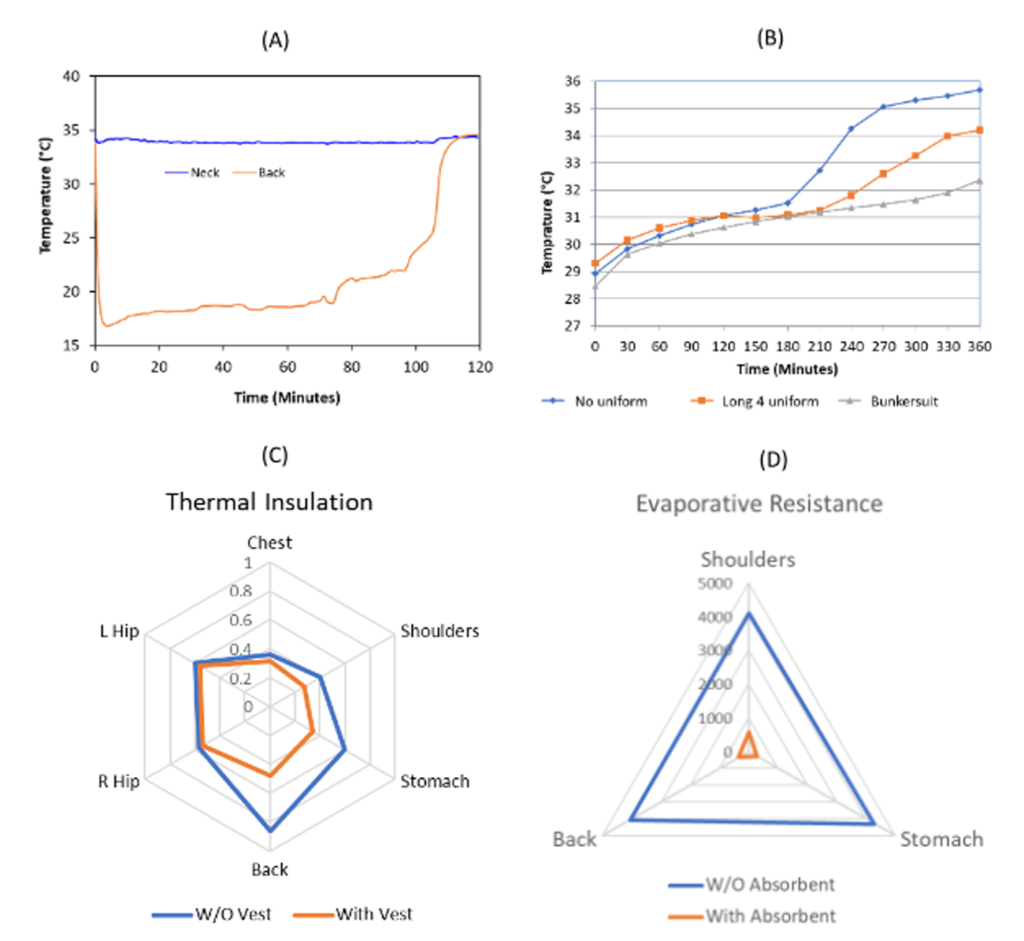
As shown in Figure 2A, with an ambient temperature of 35°C, the thermoelectric module (TEM) based cooling device can reduce the temperature of the contact area (body back) to as low as 17–20°C. However, the battery life is not long enough for operations lasting more than 2 hours, which poses a logistical issue for major incidents involving long-drawn-out firefighting. In addition, the TEM, when placed over the clothing renders cooling ineffective in the case of thick PPEs that pose a high resistance to heat removal.
Phase-changed material (PCM)
The PCM-based cooling vest is capable of cooling the whole torso area, and the cooling effect is less dependent on the ambient air. Therefore, it can be used in hot and humid environments. It is also interesting to know that, in a hot environment, the cooling effect from PCM lasts longer under a uniform with higher thermal resistance (e.g. the thick bunkersuit as shown in Figure 2B). This is mainly because PCM receives slower heat transfer from the ambient due to the additional resistance brought by the thick uniform, resulting in a longer cooling duration. However, the cooling packs are usually heavy, and it cannot remove the moisture that inhibits sweat evaporation.
Fan-based ventilation
We can see from Figure 2C that the introduction of the fan-cooling vest can reduce thermal insulation of the bunker gear for the parts it covers, namely back, shoulder, chest and stomach. This results in easier heat removal from the body and provides better thermal comfort to officers. However, the vest relies on access to ambient air to enable cooling. Thus, heat transfer and sweat evaporation is weakened or even reversed, rendering overall cooling ineffective, when the ambient air is hot and humid or inaccessible as is the case for encapsulated suits. This is a significant limitation given the extreme conditions the firefighters operate in.
Desiccant (water-vapour absorption)
Conversely, cooling packs with desiccants can effectively absorb water vapour. As shown in Figure 2D, the evaporative resistance of a medical PPE can be significantly lowered after introduction of an absorbent film. This is a desirable effect as it promotes higher amounts of sweat evaporation from the wearer’s body to reduce heat strain. However, these packs fail to lower skin temperature directly. As such, cooling effects would be marginal if any, especially given the potentially heavy sweat rate experienced by firefighters.
Figure 2: Cooling performance of various devices. (A) and (B) show the temperature evolution with a TEM cooling device and PCM cooling vest, respectively. (C) shows the thermal insulation the bunker gear with or without the fan-based cooling vest, while (D) shows the evaporative resistance of a medical PPE with or without the absorbent.5 The results were measured using the Newton thermal manikin.
Personal cooling devices for the future
The findings gathered thus far underline the need for developing a hybrid cooling strategy leveraging on two or more complementary technologies. For this purpose, potential candidates will be iteratively tested, designed and prototyped first in the lab and then in the field to ensure that both usability and cooling performance requirements are met. A key research direction will be to raise the cooling efficiency of the devices, and a hybrid cooling strategy will be central to this effort
An approach that holds promise will be to enable cooling in hot and humid environments by integrating fan-based technology with TEM and water-vapour absorption so that air drawn in by the fan can be pre-cooled by TEM and pre-dried by desiccant before it is blown to the human skin.
Alternatively, PCM and water-vapour absorption may function synergistically where a subset of PCM packets in a cooling vest can be replaced by hydrogel packets to reduce the overall weight without compromising on the overall cooling performance.
Rapid progress in material science may produce new phase change materials which are lighter and operate over a longer duration at lower phase-change temperatures yet demand mild air-conditioned environments for phase reversal. Additionally, more energy-efficient and greener thermoelectric modules which consume less energy may also be a reality in the future.
Lastly, advancements in AI and big data offer the opportunity to develop more intelligent and customized cooling devices, for example in the areas of battery management and ergonomic design of cooling devices optimized for our local firefighters.
With the threat of climate change looming over our heads, it seems ever more urgent to develop effective and efficient heat-mitigation technologies, and personal cooling devices are critically important in enhancing the sustainment and performance of our firefighters. Our aim is to establish a library of personal cooling devices, evaluate their performances, understand their merits and limitations and develop a bespoke cooling technology for SCDF emergency responders.
References
1. ‘Firefighter Radios may fail during high-temp fires’, www.nist.gov, 2006
2. Yazdi and Sheikhzadeh. Journal of The Textile Institute (2014), 105(12): 1231-1250
3. Sarkar and Kothari. Indian Journal of Fibre & Textile Research (2014), 39: 450-458
4. Yang et al. Small 2022, 2107636
About the Author

Dr Deng Rensheng
Dr Deng Rensheng is a Lead Scientist in the Human Factors and Simulation Centre of Expertise, Home Team Science and Technology Agency (HTX), Singapore. His current research interests include ensembles evaluation, cooling solutions, training manikins, load carriages and digital human modelling.

LTC Hasan Kuddoos
LTC Hasan Kuddoos is a Commander Fire Station at the Singapore Civil Defence Force. Prior to his current appointment, he was a principal officer at the Responder Performance Centre. He is involved in a number of human factors and exercise science studies to optimise performance and enhance safety of Emergency Responders.

Dr Saravana Kumar
Dr Saravana Kumar is a Deputy Director for Modelling & Simulation at the Human Factors & Simulation Centre of Expertise (HFS CoE) from the Home Team Science & Technology Agency spearheading R&D initiatives in predictive ergonomics, training and front-line operations.
