

Belt and Road Joint-Emergency Response Exercise 2023
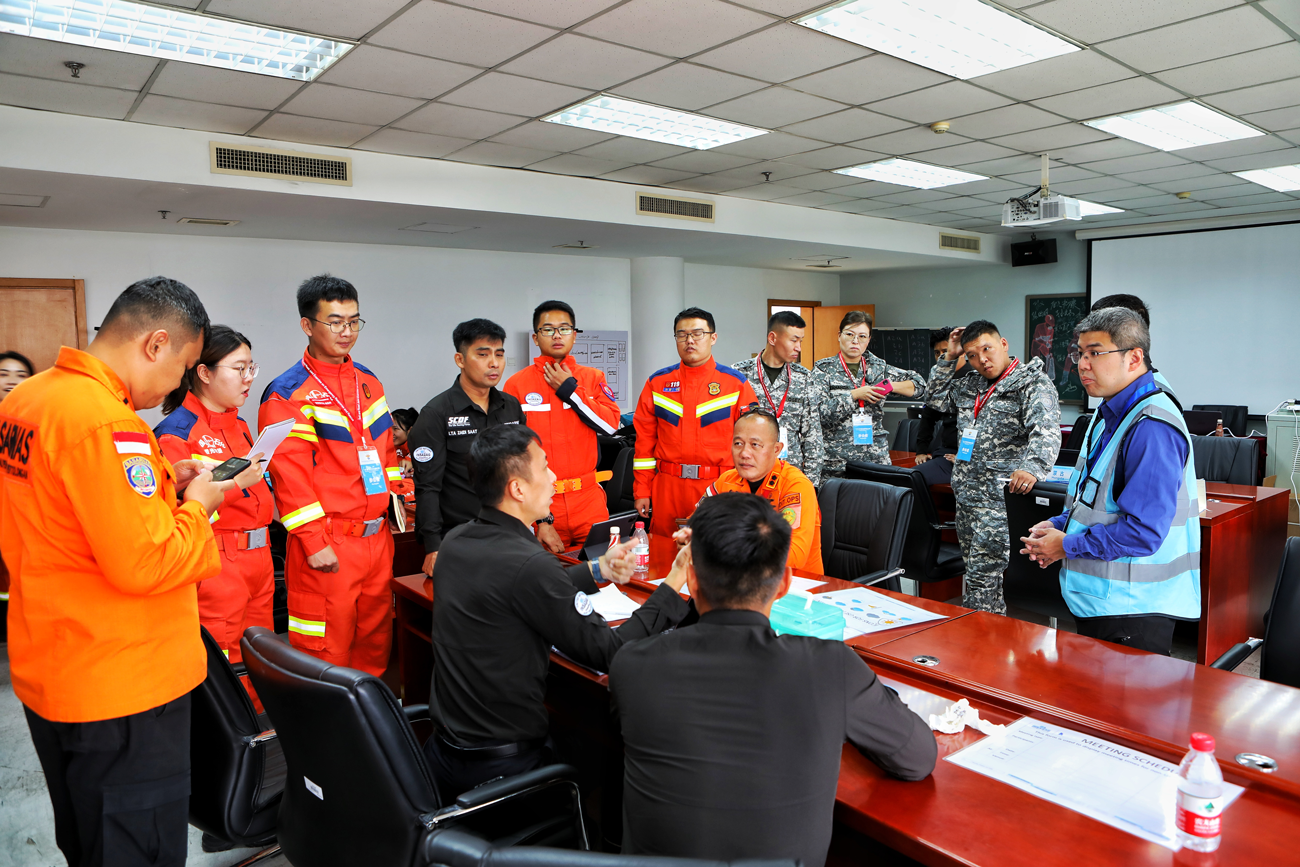
In order to enhance the cooperation in the field of large-scale natural disasters, the Ministry of the Emergency Management (MEM) of China organized the ‘Belt and Road Joint-Emergency Response Exercise’ on 10–12 October 2023 in Beijing, China. The exercise was well attended by over 170 representatives including urban search and rescue (USAR) teams from China, Indonesia, Malaysia, Mongolia, Pakistan, Belarus, Singapore and Thailand, and delegates from international organizations.
Before the exercise commenced, Mr Wang Shiguo, Director of the National Earthquake Response Support Service (NERSS) of MEM delivered the opening remarks; Mr Ramesh Rajasingha, Director of Coordination Division, United Nations Office for the Coordination of Humanitarian Affairs (OCHA) and Mr Winston Chang, Global Lead of United Nations International Search and Rescue Advisory Group (INSARAG) Secretariat delivered the opening and keynote addresses respectively. Mr Wang and Mr Ramesh together with other senior officials also unveiled a memorial plaque to mark the opening of the Belt and Road International Cooperation Framework for Disaster Risk Reduction and Emergency Management (BRIDRREM) Training Base for USAR. The emergency response exercise was started after the ceremony.
Mobilization
The start of the exercise simulated a significant earthquake in Sichuan Province which had caused severe damage to buildings and roads as well as serious casualties. As the local emergency response capacity was exceeded, the Chinese government requested bilateral assistance from USAR teams of Belt and Road countries.
Based on the INSARAG Guidelines, which are the globally recognized search and rescue standards, the participating USAR teams simulated the activation procedures, such as seek approval from the Chinese government before departure and went through Customs, Immigration and Quarantine (CIQ) clearance procedures at the affected country’s airport. After that, the international USAR teams reported at the Reception and Departure Centre (RDC) at the airport, which was set up by the local USAR team, for receiving the latest information of the disaster, such as the affected locations, weather forecast, communication with the local emergency management authority (LEMA) and logistic support, etc. The roles of airport staff and CIQ officers were acted out by the NERSS officials.

Operations
The participating USAR teams were later assigned to different sectors to set up their Base of Operations (BoO). The USAR team’s mobile headquarters at the disaster scene consists of communications hub, equipment store, medical tent, accommodation, etc. In real operations, the BoO might be located in a theme park, stadium or football field. The international USAR teams and the local USAR teams took the opportunity to share their experience of setting up a BoO with consideration to topography and utilities.
On the second and third days, the exercise simulated Days 2 to 7 after the earthquakes. The USAR Coordination Mechanism was well established, with every sector coordinated by a Sector Coordination Cell (SCC). One of the USAR teams in each sector was designated as the Sector Coordinator, which is responsible for coordinating and monitoring the operations as well as communicating with the USAR Coordination Cell (UCC) run by LEMA. Several experienced personnel from international and local USAR teams were invited to act as Exercise Controllers (ExCon), to ensure that the exercise ran smoothly and advised to participants if necessary.
In a major disaster, Assessment Search and Rescue (ASR) is an important part of USAR coordination. The five operational levels cover the USAR operation phases between initial assessment of the affected area and recovery of the last deceased victim – ASR1: Wide Area Assessment, ASR2: Sector Assessment, ASR3: Rapid Search and Rescue, ASR4: Full Search and Rescue and ASR5: Total Coverage Search and Recovery.
After the setting up of the BoO, the SCC received the assignment from the UCC. Several potential rescue locations were located by LEMA after ASR1. Therefore, the participating USAR teams were assigned by SCC to carry out the ASR2. They needed to use designated INSARAG Forms and the INSARAG Coordination and Management System (ICMS) for collecting information in ASR2 at the individual rescue location (named worksite), to identify and maximize life-saving opportunities.
With a view to enhancing operational efficiency, the ICMS is commonly used in large-scale USAR operations. It is an effective application that collects and analyses data during disaster response using mobile devices. Different stakeholders can select information to be shown on the real-time dashboard to monitor the situation.
Afterwards, the UCC analysed the data collected, prioritized and allocated the worksites for ASR3 and/or ASR4 into sectors based on the numbers of likely victims and void size as well as the required resources and operational time. Under the coordination by the UCC and SCC, the participating USAR teams carried out the ASR3 and ASR4 at identified worksites in an evolving situation.
In each ASR, the ExCon also conducted the debriefing, which enabled participants to share lessons they had learned.
Demobilization
Considering that the possibility of further on-site rescue was very low, and the local USAR capacity was sufficient to respond to the current situation, the Chinese Government declared the end of the international USAR operation on Day 8. Therefore, the UCC announced the demobilization. All international USAR teams were simulated to execute the demobilization and donation procedures.
The exercise was successfully completed after the final debriefing, and the participants shared the experiences and insights they had gained.
Highlights of the exercise
Offering strong and practical opportunity
The exercise was held in the National Earthquake Emergency Rescue Training Base. There were many mock collapsed structures. It enabled the USAR teams to practice in a realistic environment. Furthermore, the actors were arranged to act as casualties, landlords and media to provide critical information to the participants. In addition, the participants were required to handle simulated enquiries from the media.
Collective wisdom and experience
The exercise offered many practical learning opportunities for the participants. For example, the international and local USAR teams worked together at the sectors so that they could share lessons learned and best practices between each other. The experienced ExCon also injected various unexpected incidents which requiring immediate response of participants. It helped to test their decision-making skills in critical situation. The ExCon and participants as well as actors also benefitted from the reaction to understand the workflow of international USAR operations.
Enhancing cooperation between the Belt and Road Countries’ USAR teams
As extreme weather becomes more frequent, huge natural disasters are expected to increase. International humanitarian assistance can be requested in extreme situations. These joint exercises help to strengthen mutual connection and cooperation, as well as establish the partnership with the USAR teams of Belt and Road countries.
Conclusion
In the past 10 years, the international humanitarian assistance mechanism was activated many times, including for the Nepal earthquake (2015), Beirut Port Explosion (2020) and Turkey–Syria earthquakes (2023). The operation’s success depends on precise coordination through unimpeded communications among all USAR teams. Undoubtedly, the exercise enabled all participants to get more familiar with the INSARAG Guidelines and the Coordination Mechanism and helped them to tackle the new challenges of performing disaster response work in the future.
About the Author

Mr Bruce Wong is Country Representative of the International Association of Emergency Managers and USAR instructor of the International Technical Rescue Association.
